
Your credit score controls more of your financial life than most people realize. It determines the interest rate on your mortgage, whether you qualify for that business loan, and even how much you pay for car insurance. The good news? You do not have to wait years to see meaningful improvement. With the right strategies applied in the right order, you can learn how to improve your credit score fast and see results in as little as 30 days.
This guide breaks down seven proven, data-backed steps ranked by how quickly they deliver results. No vague advice, no gimmicks. Just the specific actions that move your score the most in the shortest time.
In this article, you will learn:
Quick answer: The fastest way to improve your credit score is to lower your credit utilization below 10%, dispute errors on your credit reports, and automate on-time payments. Most people can see a 30-90 point improvement within 30-60 days by combining these strategies. For the dispute step, M1’s AI credit repair tool can help you prepare targeted letters for inaccurate credit report information.
- The 7 fastest strategies to raise your credit score, ranked by impact
- How each FICO scoring factor works and which ones to target first
- A realistic 30-60-90 day timeline for score improvement
- How AI-powered tools can automate the most time-consuming steps
- Answers to the most common credit score questions
Why Your Credit Score Matters More Than You Think
Before diving into the steps, it helps to understand what is at stake. Your FICO score ranges from 300 to 850, and even a modest improvement of 50 points can translate into thousands of dollars saved over the life of a loan.
Here is what different score ranges mean for your finances:
- 740-850 (Excellent): Best interest rates, easiest approvals, lowest insurance premiums
- 670-739 (Good): Competitive rates, broad access to credit products
- 580-669 (Fair): Higher rates, limited options, may require secured products
- 300-579 (Poor): Difficulty getting approved, very high interest rates, larger deposits required
Your score is calculated using five core factors, each carrying different weight:
| Factor | Weight | What It Measures |
|---|---|---|
| Payment History | 35% | On-time vs. late payments |
| Credit Utilization | 30% | How much of your available credit you use |
| Length of Credit History | 15% | Age of your oldest and average accounts |
| Credit Mix | 10% | Variety of account types |
| New Credit Inquiries | 10% | Recent applications for credit |
Understanding these weights is the key to knowing what affects your credit score and where to focus your effort for the fastest results. The steps below target the highest-weight factors first.
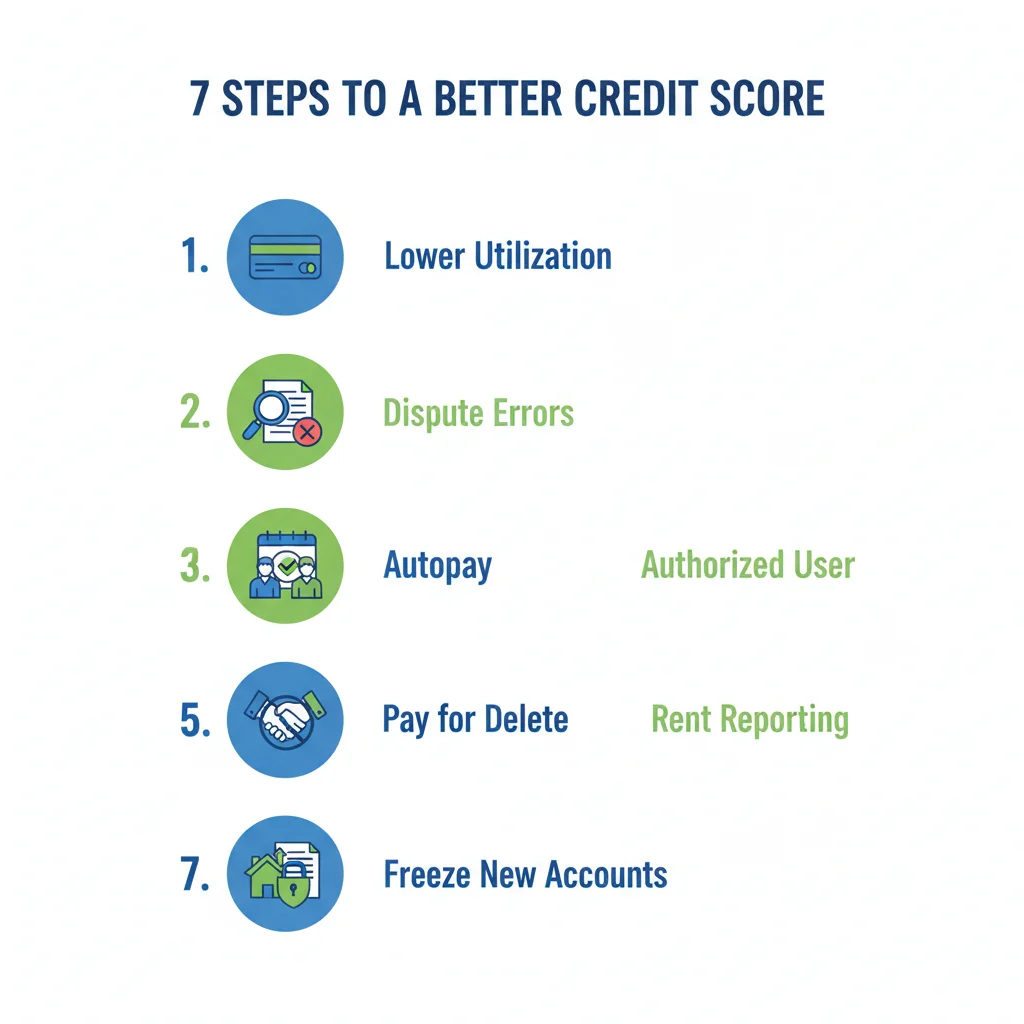
Step 1: Lower Your Credit Utilization Below 10%
Potential impact: +20 to 50 points | Timeline: 1-5 days after reporting
Credit utilization, the percentage of your available credit you are currently using, is the single fastest lever you can pull. It makes up 30% of your FICO score and, unlike payment history, it has no memory. Your score recalculates every time your card issuer reports a new balance.
Here is how to calculate it:
Utilization = (Total Credit Card Balances / Total Credit Limits) x 100
If you have $3,000 in balances across cards with $10,000 in total limits, your utilization is 30%. That is already at the threshold where scoring models start penalizing you.
What to do right now:
- Pay down your highest-utilization cards first. Focus on cards where the balance-to-limit ratio is highest, not the card with the biggest balance.
- Target below 10% overall and below 30% per card. Research from FICO shows that consumers with scores above 750 typically maintain utilization under 7%.
- Time your payments strategically. Pay your balance before the statement closing date, not just the due date. Your issuer reports the statement balance to the bureaus, so paying early means a lower reported utilization.
- Request a credit limit increase. If you cannot pay down balances immediately, increasing your limit achieves the same mathematical effect. Many issuers allow this through their app or website with no hard inquiry.
For a deeper dive into utilization strategies, read our guide on credit utilization tips to boost your score.
Pro tip: If you are applying for a mortgage or auto loan soon, pay your cards to near-zero balances before the statement closing date for the maximum score boost.
Step 2: Dispute Errors on Your Credit Reports
Potential impact: +25 to 50+ points | Timeline: 30-45 days
According to a landmark FTC study, one in five consumers has an error on at least one credit report that is significant enough to affect their score. These errors include accounts that do not belong to you, incorrect late payment records, wrong balances, and outdated negative items that should have aged off.
How to dispute effectively:
- Pull your free reports. You are entitled to free weekly reports from all three bureaus through AnnualCreditReport.com. Check your credit score and review each report carefully.
- Document everything. For each error, note the account number, the incorrect information, and what the correct information should be. Gather supporting documents such as bank statements, payment receipts, or correspondence.
- File disputes with each bureau. You can dispute online, by mail, or by phone. Mailing a dispute letter via certified mail creates a paper trail, which matters if you need to escalate.
- Use AI to speed up the process. Reviewing three reports line by line and writing custom dispute letters is time-consuming. AI-powered credit repair tools can scan your reports, identify inaccuracies automatically, and generate legally sound dispute letters tailored to each item.
The bureaus have 30 days to investigate (45 if you provide additional information). If they cannot verify the disputed item, they must remove it by law under the Fair Credit Reporting Act (FCRA).
For a complete walkthrough, see our guide to cleaning up your credit report.
Step 3: Set Up Automatic Payments to Protect Payment History
Potential impact: Prevents 60-100+ point drops | Timeline: Immediate
Payment history is the single largest factor in your credit score at 35%. A single payment that is 30 days late can drop your score by 60 to 100 points, and the damage stays on your report for seven years. This step is as much about defense as it is about offense.
Your action plan:
- Enable autopay for at least the minimum payment on every credit card, loan, and recurring bill. This ensures you never accidentally trigger a late payment.
- Set calendar reminders 5 days before due dates. Even with autopay, it helps to know when payments are coming so you can ensure sufficient funds are available.
- Prioritize catching up on any past-due accounts. If you have accounts that are currently past due, bring them current immediately. While the late payment mark remains on your report, getting current stops the bleeding and prevents further damage.
- Negotiate with creditors if needed. If you have a single late payment on an otherwise clean account, call the creditor and ask for a “goodwill adjustment.” Many will remove it as a one-time courtesy, especially if you have been a long-term customer.
Consistency is the foundation of learning how to build credit that lasts. Every on-time payment adds a positive data point to your history.
Step 4: Become an Authorized User on a Trusted Account
Potential impact: +15 to 30 points | Timeline: 1-2 billing cycles
This strategy is one of the least understood and most underused ways to improve your credit score fast. When someone with excellent credit adds you as an authorized user on their credit card, their entire payment history on that account can be added to your credit report.
How it works:
- The primary cardholder’s positive payment history, low utilization, and account age get reported to your credit file.
- You do not need to use the card or even have physical possession of it.
- The benefit is most powerful when the account has a long history (5+ years), a high credit limit, and zero late payments.
Important considerations:
- Choose carefully. Only accept authorized user status on accounts with perfect payment history. If the primary cardholder misses a payment, it hurts your score too.
- Not all issuers report authorized users. Confirm with the card issuer that they report authorized user accounts to all three credit bureaus before proceeding.
- This works best for thin credit files. If you have limited credit history, the impact can be significant. For established credit files, the effect is smaller but still positive.
Step 5: Negotiate Pay-for-Delete Agreements on Collections
Potential impact: +25 to 45 points per removed account | Timeline: 30-60 days
If you have collection accounts on your credit report, they are likely doing significant damage to your score. A pay-for-delete agreement is a negotiation strategy where you offer to pay the collection agency in exchange for them removing the account from your credit reports entirely.
Step-by-step approach:
- Verify the debt is legitimate. Send a debt validation letter within 30 days of first contact. The collector must provide proof that the debt is yours and the amount is correct.
- Negotiate in writing. Never agree to anything over the phone without written confirmation. Offer to pay a percentage of the balance (start at 30-50%) in exchange for complete removal from all three credit reports.
- Get the agreement in writing before paying. This is non-negotiable. Without written confirmation of the pay-for-delete terms, you have no leverage if they take your payment but do not remove the account.
- Pay via cashier’s check or money order. Avoid giving collectors direct access to your bank account.
For templates and detailed instructions, see our guide on how to write a pay-for-delete letter that works.
Important note: Not all collectors agree to pay-for-delete, and newer FICO scoring models (FICO 9 and 10) already ignore paid collections. However, many lenders still use older FICO models where paid collections count against you, so removal provides the most consistent benefit.
Step 6: Add Positive Data With Rent and Utility Reporting
Potential impact: +10 to 25 points | Timeline: 2-4 weeks
Most people pay rent and utilities on time every month, but those payments traditionally do not count toward your credit score. Services like Experian Boost and rent-reporting platforms change that by adding your on-time payment history for rent, utilities, streaming services, and even phone bills to your credit file.
How to take advantage:
- Sign up for a rent and utility reporting service. These services verify your payment history and report it to one or more credit bureaus.
- Link your bank account. The service scans your transaction history to identify eligible recurring payments.
- See near-instant results. Many users see a score increase within a few days of adding positive payment data.
This strategy is especially powerful for people with thin credit files, such as young adults, recent immigrants, or anyone who has avoided traditional credit products. It creates positive history without requiring you to take on new debt.
Step 7: Avoid Opening New Accounts (For Now)
Potential impact: Prevents 5-15 point drops per inquiry | Timeline: Immediate
Every time you apply for new credit, the lender pulls a hard inquiry on your report. Each inquiry can lower your score by 5 to 15 points and stays on your report for two years. When you are actively working to improve your credit score fast, the last thing you want is to undermine your progress with unnecessary inquiries.
Smart rules to follow:
- Freeze new credit applications until you have completed steps 1 through 6 and your score has stabilized at a higher level.
- Rate-shop within a focused window. If you need to shop for a mortgage, auto loan, or student loan, do so within a 14-45 day window. FICO treats multiple inquiries for the same loan type within this period as a single inquiry.
- Use pre-qualification tools. Many lenders offer pre-qualification checks that use soft inquiries, which do not affect your score. Use these to gauge approval odds before formally applying.
- Keep existing accounts open. Closing old accounts shortens your average account age (15% of your score) and reduces your total available credit (increasing utilization). Even if you are not using a card, keep it open with a small recurring charge.
If you are rebuilding credit and do need a new card, secured credit cards or credit cards for rebuilding credit with no annual fee are designed for this purpose and typically have lower approval thresholds.
Your 30-60-90 Day Credit Score Improvement Timeline
Improving your credit score is not a single event. It is a sequence. Here is how to prioritize these steps for maximum impact:
Days 1-7: Quick Wins
- Calculate your utilization ratio and pay down balances below 10% (Step 1)
- Pull all three credit reports and identify errors (Step 2)
- Set up autopay on all accounts (Step 3)
- Ask a family member about authorized user status (Step 4)
Days 8-30: Build Momentum
- File disputes for all documented errors (Step 2)
- Send pay-for-delete letters to collection agencies (Step 5)
- Sign up for rent/utility reporting (Step 6)
- Freeze new credit applications (Step 7)
Days 31-60: Follow Through
- Check dispute results and escalate if needed
- Follow up on pay-for-delete negotiations
- Review your updated credit reports for accuracy
- Request credit limit increases on existing cards
Days 61-90: Lock In Gains
- Re-check all three reports for remaining errors
- Evaluate progress and adjust strategy
- Begin planning next credit goals (mortgage pre-approval, business credit, etc.)
- Explore AI-powered credit repair tools to automate ongoing monitoring
How AI Is Changing Credit Repair
The traditional approach to credit repair, manually reviewing reports and writing dispute letters, works but takes a significant amount of time. AI-powered platforms like M1 Credit Solutions are changing that by automating the most tedious parts of the process.

Here is what AI credit repair tools can do:
- Scan your credit reports from all three bureaus and automatically identify inaccurate, outdated, or questionable items
- Generate customized dispute letters that are legally sound and tailored to each specific item
- Track your progress through a real-time dashboard so you always know where you stand
- Save you time and money compared to hiring a traditional credit repair company
Instead of spending hours parsing through dense credit reports, you can connect your reports and let the AI do the analysis. This is the benefit of DIY credit repair taken to the next level. You stay in control while technology handles the heavy lifting.
Get Started With M1 Credit Solutions
Frequently Asked Questions
How fast can I realistically improve my credit score?
The speed depends on what is dragging your score down. If high credit utilization is the primary issue, you can see a 20 to 50 point improvement within a single billing cycle (1-5 days after the lower balance is reported). Disputing errors typically takes 30-45 days but can yield 25 to 50+ points. Combining multiple strategies, many people see meaningful improvement within 30 to 90 days.
Can I improve my credit score by 100 points fast?
A 100-point improvement is realistic within 2-3 months if you have multiple issues to address, such as high utilization, report errors, and collection accounts. Paying down utilization alone can account for 20-50 points, and successful disputes can add another 25-50 points. The more issues present, the more room there is for rapid improvement.
How can I improve my credit score fast for free?
Several strategies cost nothing: paying down existing balances, disputing errors through the bureaus’ free online portals, setting up autopay, and using free services to add rent and utility payments to your credit file. You can also check your credit score for free through several reputable services.
Does checking my own credit score lower it?
No. Checking your own credit score is a soft inquiry and has zero impact on your score. You can check as often as you want without any negative effect. Only hard inquiries from credit applications affect your score.
How to improve credit score fast to buy a house?
Focus on Steps 1 through 3 in this guide: lower utilization below 10%, dispute all errors, and ensure every payment is on time. Mortgage lenders look at your middle score (the median of your three bureau scores), so address issues across all three reports. Start this process at least 90 days before applying for a mortgage (see our guide on what credit score you need for the best mortgage rates) to give disputes time to resolve and new balances to report.
Is it worth using a credit repair company?
Traditional credit repair companies charge monthly fees for work you can do yourself. AI-powered platforms offer a middle ground, providing the automation and expertise of a service with the transparency and affordability of doing it yourself. Our guide to effective credit repair walks you through exactly what these services do so you can make an informed decision.
Take Control of Your Credit Score Today
Improving your credit score fast is not about finding a secret hack. It is about targeting the right factors in the right order and being consistent. Start with utilization (the fastest win), dispute any errors (the biggest hidden opportunity), lock in good payment habits (the strongest long-term foundation), and use every tool available to add positive data to your file.
Every step you take puts you closer to better interest rates, easier approvals, and more financial freedom. The tools and strategies in this guide work whether you are rebuilding from a low score or optimizing an already decent one.
Ready to take the next step? M1 Credit Solutions gives you AI-powered tools to scan your credit reports, identify issues, and generate dispute letters automatically. No expensive agencies, no guesswork, just you in control with technology doing the heavy lifting. For more details, see our guide on business credit building guide.