
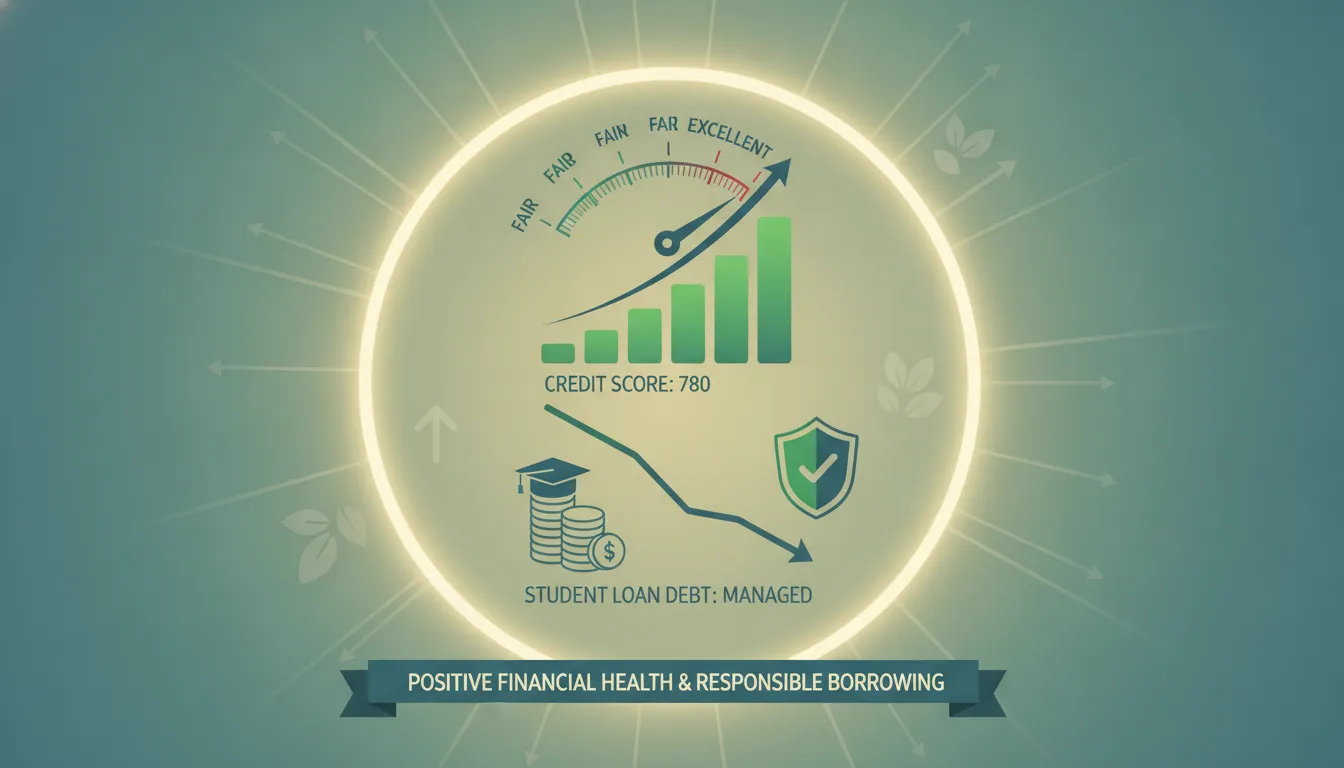
A single missed student loan payment can drop your credit score by 100 points or more. But the right payment strategy can turn that same debt into a powerful credit-building tool. Talk to an M1 Credit Solutions advisor about optimizing your student loan strategy today.
Do student loans affect credit score? Yes. They appear on your credit report as installment debt and influence all five FICO scoring factors. Payment history carries the most weight at 35 percent, making every on-time payment a credit-building event. Late payments, deferments, and defaults each leave distinct marks on your report. Understanding how these loans interact with your credit profile helps you avoid pitfalls and build a stronger financial foundation.
Do Student Loans Affect Credit Score: How Student Loans Affect Your Credit Score
Do student loans affect credit score immediately? Yes. From the moment your loan is disbursed, it appears on your credit report as an installment account. Unlike revolving credit such as credit cards, student loans carry a fixed payment schedule and a set term length. This distinction matters because the credit scoring algorithms treat installment debt differently from revolving debt.
Student loans affect your credit score through all five FICO scoring categories: payment history (35 percent). Amounts owed (30 percent), length of credit history (15 percent), credit mix (10 percent), and new credit (10 percent). On-time payments build positive history, while missed payments can damage your score for years.
The Consumer Financial Protection Bureau confirms that your loan balances and payment activity are reported to all four major credit bureaus. This means your student loan behavior directly shapes your credit profile from the very first payment cycle.
Here is how each scoring factor is affected:
- Payment history (35 percent): Every on-time payment builds a positive record. A single 30-day late payment can drop a good score by 60 to 110 points.
- Amounts owed (30 percent): Your total student loan balance contributes to your overall debt load, though installment debt is weighted less heavily than revolving debt.
- Length of credit history (15 percent): Student loans are often a person’s first major credit account, establishing an early start for credit age.
- Credit mix (10 percent): Having both installment loans and revolving credit demonstrates to lenders that you can manage different types of debt.
- New credit (10 percent): Each student loan application triggers a hard inquiry, which can temporarily lower your score by a few points.
Understanding these mechanics is the first step toward using student loans strategically. The way you manage this debt sends signals to future lenders about your reliability as a borrower.
Can Student Loans Help or Hurt Your Credit Score?
Student loans are a double-edged sword for your credit profile. When managed well, they build a strong payment history and diversify your credit mix. When mismanaged, late payments and default can devastate your score. The outcome depends entirely on your payment strategy and awareness of how these accounts are reported.
Student loans can help your credit by establishing a positive payment history and improving your credit mix. They can hurt your credit through late payments, default, and high debt-to-income ratios. The net effect depends on consistent on-time payments and active account management.
How they help your credit
The most direct benefit comes from on-time payments. Each month that you pay before the due date adds a positive entry to your credit report. Over four or five years of standard repayment, that creates a substantial history of responsible borrowing. FICO scoring models recognize this track record as evidence of stability.
Credit mix improvement is another advantage. Scoring models reward borrowers who successfully manage different types of credit. A borrower who carries only credit cards has a thin credit mix. Adding a student loan shows that you can handle fixed installment payments over an extended period. According to myFICO, the official FICO education resource, installment debt is also weighed less aggressively than revolving debt in your credit utilization calculations. A $30,000 student loan balance typically has a smaller negative impact on your score than a $5,000 maxed-out credit card.
How they hurt your credit
The damage from student loans comes primarily through missed payments. Your credit score reflects every missed payment for up to seven years. A single 90-day delinquency can drop a 700 score into the high 500s. Default triggers even more severe consequences, including wage garnishment and tax refund seizure, in addition to the credit damage.
High debt loads also affect your debt-to-income ratio, which lenders evaluate when you apply for mortgages or auto loans. Even with perfect payment history, $80,000 in student debt can make it harder to qualify for a home loan. M1 Credit Solutions can help you develop a plan to manage student debt while protecting your credit profile.
How Payment History Shapes Your Credit Score with Student Loans
Payment history is the single largest factor in your FICO score, accounting for more than a third of the total calculation. For student loan borrowers, this means that every monthly payment carries outsized weight compared to other credit behaviors. The consistency of your payments over years matters more than the loan balance itself.
Your student loan payment history accounts for 35 percent of your FICO score. On-time payments build a positive record that stays on your report for up to 10 years, while late payments remain for seven years. Lenders evaluate this history as a primary indicator of borrowing reliability.
The power of on-time payments
Each on-time payment is a data point that credit scoring models use to predict your future reliability. Federal student loans typically have a 120-day grace period before a late payment is reported to credit bureaus. But private lenders may report as early as 30 days past due. Understanding your specific loan terms helps you protect your score.
For borrowers just starting their credit journey, student loans offer a structured path to building history. The fixed monthly payment acts as forced discipline. Unlike credit cards, where you control the spending amount, student loans require a predictable monthly obligation. Handling that obligation consistently demonstrates financial maturity to underwriters.
The cost of late payments
A single late payment can offset months of positive history. The severity of the impact depends on your starting score. A borrower with a 780 score might see a 90 to 110 point drop from a 30-day delinquency. Recovery takes six to nine months of consecutive on-time payments. Borrowers with lower scores experience smaller absolute drops but longer recovery periods.
Credit bureaus track delinquency in stages: 30, 60, 90, 120, and 180 days. Each stage increases the damage to your score. After 270 days of non-payment, federal student loans enter default. The default entry remains on your credit report for seven years from the date it was first reported late.
What Happens During Deferment, Forbearance, and Income-Driven Repayment?
Special payment arrangements change how student loans interact with your credit report. Each option carries distinct implications for your score, and the differences matter for long-term credit health. Borrowers who understand these nuances can choose the option that best protects their credit profile.
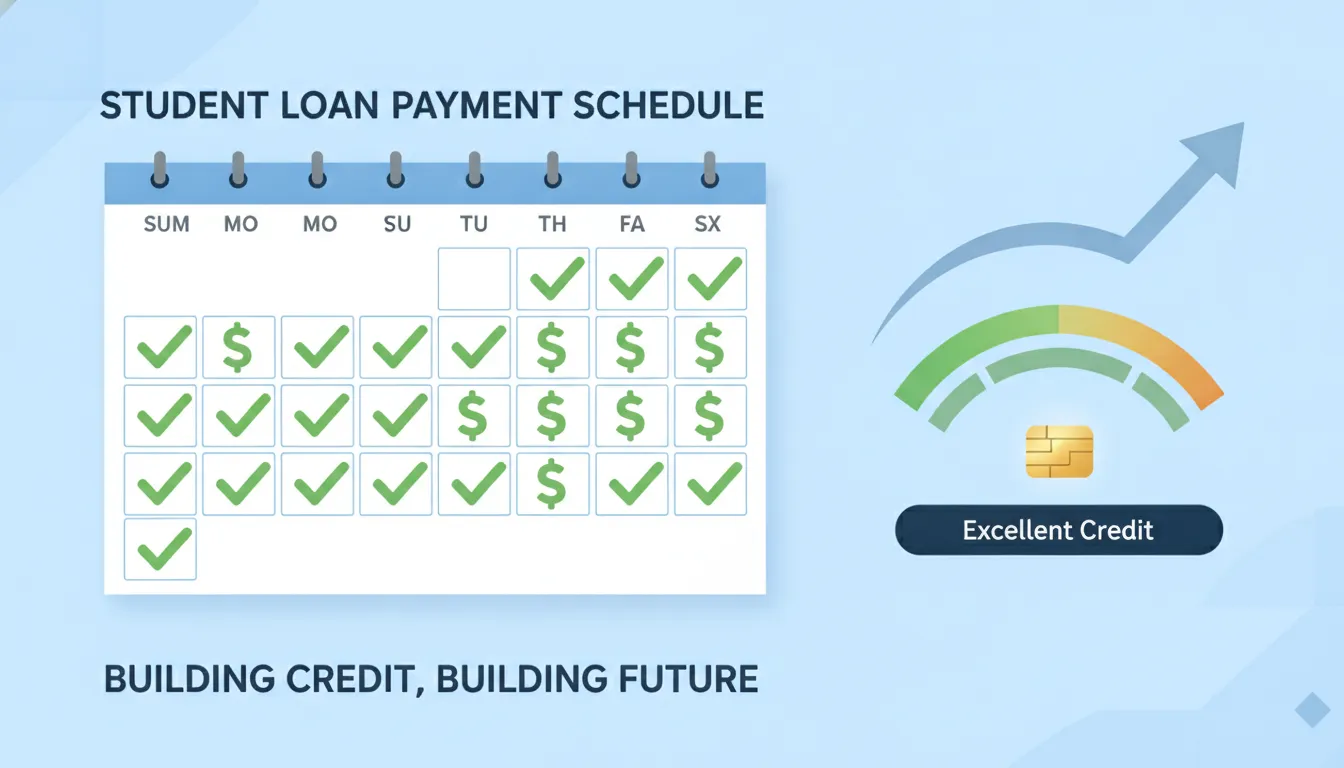
Deferment and forbearance keep your loan in current status on your credit report but do not add active payment history. Income-driven repayment plans count even zero-dollar payments as qualifying on-time payments, actively building positive history. Default reporting begins after 270 days of missed payments on federal loans.
Deferment
Deferment temporarily suspends your payment obligation, typically for situations like returning to school, economic hardship, or military service. During deferment, your loan continues to appear on your credit report as a current account. This protects you from the negative reporting that would come from missed payments. However, deferment periods do not add active payment history to your file. Your score does not climb during deferment, though it does not drop either. On subsidized federal loans, the government pays your interest during deferment. On unsubsidized and private loans, interest continues to accrue and may capitalize, increasing your total balance.
Forbearance
Forbearance is similar to deferment but with one critical difference: interest always accrues on the full loan balance. For borrowers with unsubsidized or private loans, forbearance can increase the total debt significantly. The capitalization of accrued interest means your principal balance grows, which increases your monthly payment when repayment resumes.
Like deferment, forbearance keeps your account in current status on credit reports. But the growing balance can affect your amounts-owed score component. A $40,000 loan that grows to $48,000 through interest capitalization increases your overall debt burden, which lenders consider when evaluating new credit applications.
Income-driven repayment plans
Income-driven repayment (IDR) plans adjust your monthly payment based on your discretionary income. Payments can be as low as zero dollars per month. Critically, even these zero-dollar payments count as qualifying on-time payments for credit reporting purposes. This makes IDR the most credit-positive option for borrowers who cannot afford their standard payment.
IDR plans also lead to eventual loan forgiveness after 20 or 25 years of qualifying payments. While the forgiven amount may be taxable as income, the credit benefit from years of consistent payment history is substantial. Borrowers should weigh the long-term tax implications against the immediate credit benefits when selecting this option.
The Real Cost of Student Loan Default on Your Credit
Student loan default is one of the most damaging credit events a borrower can experience. The combination of missed payment history, collection activity, and public record entries creates a compound effect that depresses scores for years. Understanding the timeline and recovery options is essential for anyone at risk of default.
Student loan default causes a 100-plus point score drop, a federal wage garnishment of up to 15 percent. And a default entry that stays on your credit report for seven years. Rehabilitation programs can remove the default notation after nine consecutive on-time payments.
The default timeline
Federal student loans follow a specific timeline before default occurs. The first missed payment starts a 270-day clock. At 90 days, the loan servicer reports the delinquency to credit bureaus. At 270 days, the loan enters default. At that point, the entire balance becomes due immediately through acceleration. The Department of Education can garnish up to 15 percent of disposable wages without a court order. Federal tax refunds can be intercepted. Collection fees of up to 20 percent can be added.
The Federal Reserve Bank of New York reported that more than nine million borrowers saw significant credit score drops in 2025 as pandemic-era protections ended and delinquencies resumed reporting. Borrowers who had been shielded by the payment pause experienced score drops of 40 to 100 points once their accounts updated.
| Loan Status | Reporting Trigger | Score Impact | Recommended Action |
|---|---|---|---|
| Current / On-time | Monthly payment | Positive build | Continue autopay |
| 30-60 days late | Servicer reports delinquency | 30-50 point drop | Pay past due amount immediately |
| 90-180 days late | Credit bureau update | 60-100 point drop | Contact servicer for hardship options |
| Default (270+ days) | Acceleration + collection | 100+ point drop | Begin loan rehabilitation |
| Rehabilitation complete | Default notation removed | Partial recovery | Continue on-time payments |
Recovery through rehabilitation
Loan rehabilitation is the most effective path to credit recovery after default. Under this program, you make nine consecutive on-time payments over 10 months. After the ninth payment, the default notation is removed from your credit report. The late payment history remains for seven years, but removing the default entry significantly improves your score.
The alternative is loan consolidation, which pays off the defaulted loan with a new direct consolidation loan. While consolidation stops collections and garnishment, the default notation stays on your credit report. Rehabilitation is almost always the better option for credit recovery.
How Student Loans Shape Your Credit Mix
Credit mix accounts for 10 percent of your FICO score, and student loans play a unique role in diversifying your credit profile. Lenders want to see that you can handle different types of debt obligations. And an installment loan like a student loan provides evidence of that capability that credit cards alone cannot offer.
Student loans improve your credit mix by adding an installment account alongside any revolving credit you hold. FICO rewards borrowers with a healthy mix of both account types. A student loan also establishes credit age early, since many borrowers take out their first loan before age 20.
Installment versus revolving debt
The fundamental difference between installment debt (student loans, mortgages, auto loans) and revolving debt (credit cards, lines of credit) is the payment structure. Installment loans require fixed payments over a set term. Revolving credit allows variable payments based on a fluctuating balance. FICO considers borrowers who successfully manage both types as lower risk.
A borrower with only credit cards has a utilization ratio that fluctuates monthly. A single large purchase can spike utilization and temporarily lower the score. An installment loan like a student loan does not carry the same utilization sensitivity. The balance is expected to be high, and the scoring model accounts for that structural difference.
Why installment debt is treated more favorably
FICO treats installment debt less aggressively than revolving debt because the payment structure is predictable. A borrower with a $40,000 student loan is not showing signs of financial distress by carrying that balance. In contrast, a borrower carrying a $5,000 balance on a $6,000 credit card is using 83 percent of available credit, which signals higher risk.
This distinction matters for your overall credit strategy. Understanding how different debt types affect your score helps you prioritize which accounts to pay down first. Focusing on credit card utilization often yields faster score improvements than aggressively paying down installment loans.
Federal vs. Private Student Loans: Key Credit Differences
Do student loans affect credit score differently depending on the loan type? Yes. Federal and private student loans follow different reporting rules, offer different borrower protections, and trigger different consequences for missed payments. Understanding these differences helps you choose the right loan type and manage it effectively.
Federal student loans offer deferment, forbearance, income-driven repayment, and loan rehabilitation options that protect your credit during financial hardship. Private student loans have fewer protections, shorter grace periods before late reporting, and no rehabilitation programs. Federal loans also offer forgiveness pathways that private loans do not.
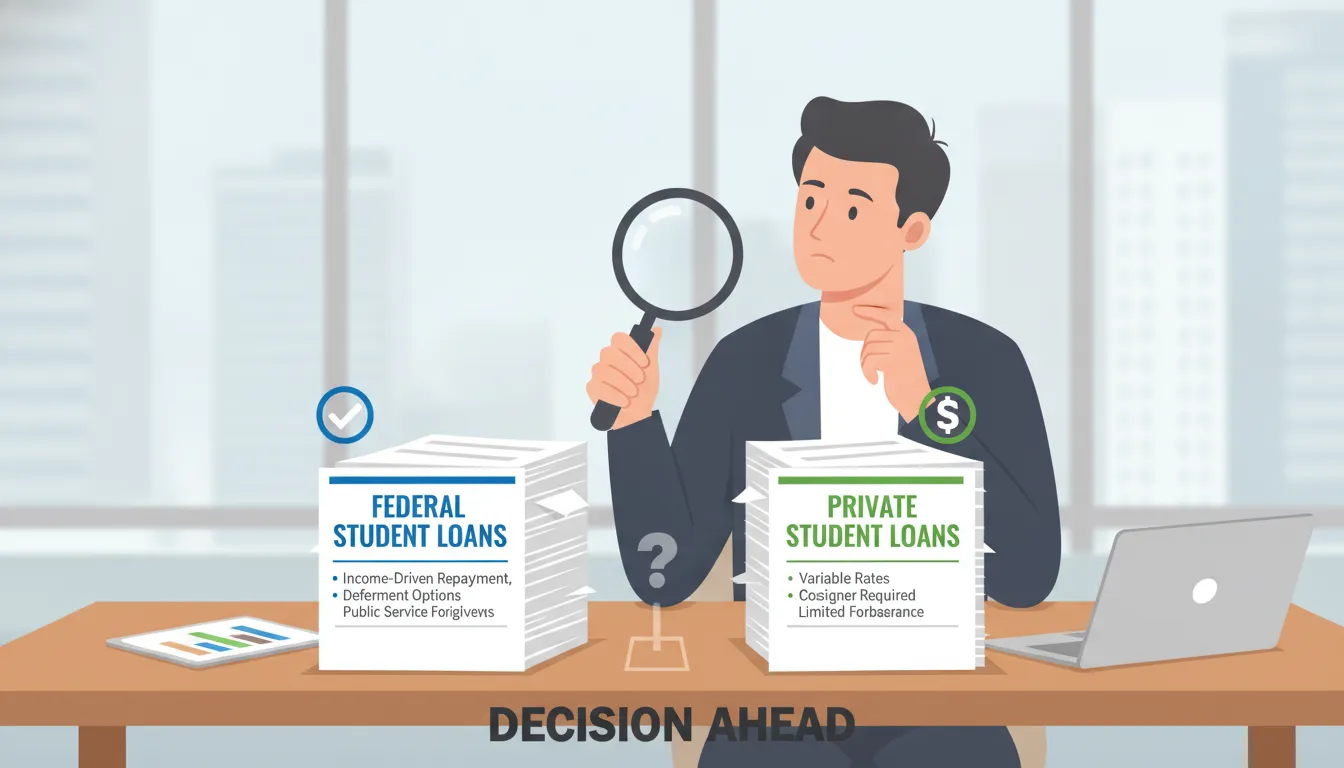
| Feature | Federal Student Loans | Private Student Loans |
|---|---|---|
| Grace period before late reporting | Up to 120 days | Typically 15-30 days |
| Deferment available | Yes, multiple options | At lender discretion only |
| Income-driven repayment | Yes (several plans) | Rarely available |
| Default timeline | 270 days missed | Varies by lender |
| Rehabilitation program | Yes, removes default | Not available |
| Forgiveness options | PSLF, IDR forgiveness | Not available |
| Wage garnishment protection | Up to 15 percent | Requires court order |
The borrower protections built into federal loans provide a significant credit safety net. A borrower who loses their job can enter deferment immediately, keeping their account current on credit reports. Private loan borrowers facing the same situation often have no equivalent option, making missed payments and credit damage more likely. This structural difference means federal loans carry less credit risk for most borrowers.
How to Use Student Loans to Build Credit
Student loans can be a deliberate credit-building tool rather than a financial burden. By applying specific strategies, borrowers can maximize the positive impact of their student loans on their credit scores while minimizing the risks. The following steps outline a practical approach.
Using student loans to build credit requires five key strategies: enrolling in autopay, making payments above the minimum. Monitoring your credit reports quarterly, keeping credit card utilization low alongside student debt, and using deferment strategically only when necessary.
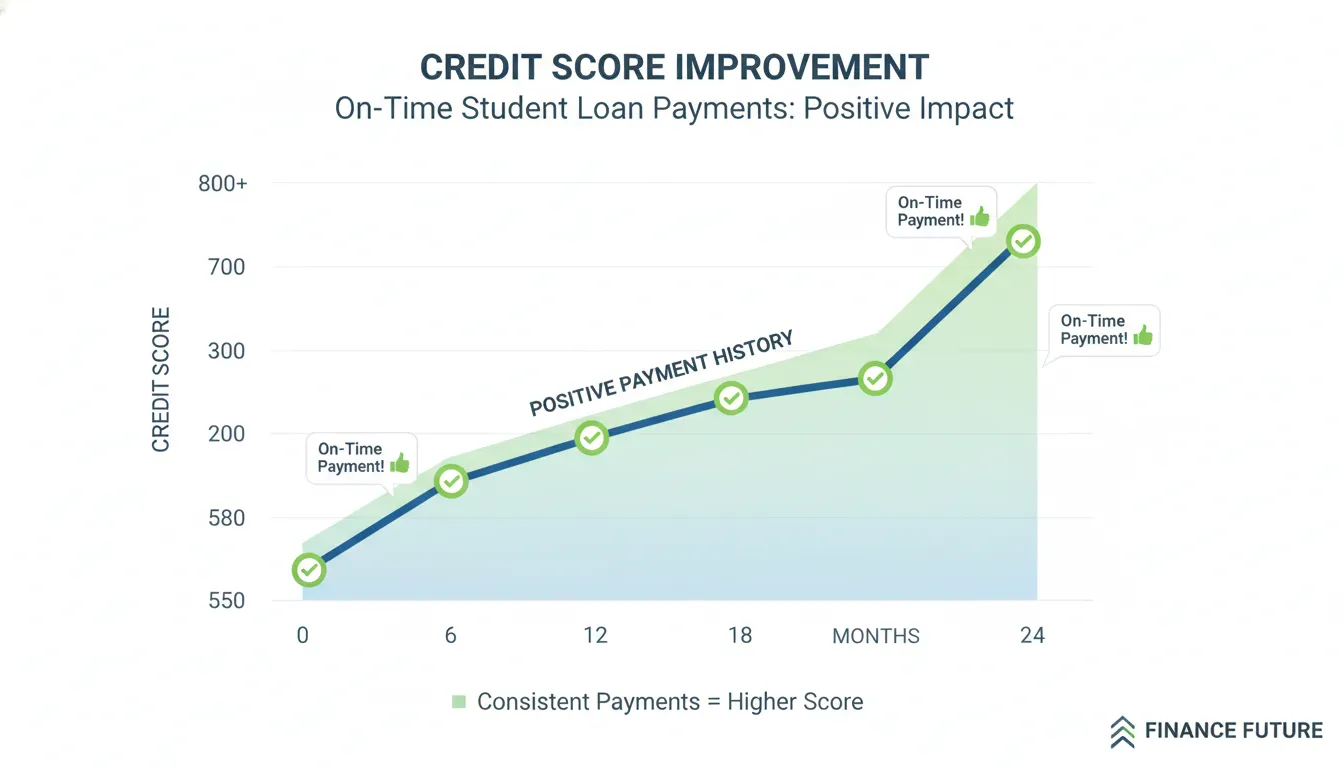
- Enroll in automatic payments. Most servicers offer a 0.25 percent interest rate reduction for autopay enrollment. More importantly, automation eliminates the risk of forgetting a payment. Consistent on-time payments are the single most effective credit-building action.
- Make payments above the minimum when possible. Extra payments reduce your principal balance faster, which lowers your total debt burden over time. Even an additional $25 per month on a $300 monthly payment accelerates principal reduction and reduces total interest paid.
- Monitor your credit reports quarterly. Pull your free annual credit reports from AnnualCreditReport.com and check for errors. Common student loan reporting errors include incorrect late payment marks, wrong loan balances, and duplicate loan entries. Disputing errors with the credit bureaus can produce meaningful score increases.
- Keep credit card utilization low alongside student debt. High credit card utilization damages your score more than high student loan balances. Prioritize keeping card balances below 30 percent of your credit limit, even if your student loan balance is substantial.
- Use deferment strategically, not as a default option. Deferment protects your credit during genuine emergencies, but using it unnecessarily delays the credit-building benefit of active repayment. Return to repayment as soon as your circumstances allow.
Schedule a free consultation with M1 Credit Solutions to develop a personalized plan for using student loans to strengthen your credit profile.
Frequently Asked Questions
Here are answers to the most common questions about how student loans affect credit scores.
Do student loans affect your credit score immediately?
Yes. The loan appears on your credit report as an installment account as soon as it is disbursed. Your payment behavior from the first billing cycle begins affecting your credit score through all five FICO factors.
How many points does a student loan late payment drop your credit score?
A 30-day late payment can drop a good score by 60 to 110 points, depending on your starting score. Higher scores experience larger absolute drops. A default can drop your score by 100 points or more.
Does paying off student loans early help your credit score?
Paying off student loans early can cause a temporary score dip because the account closes, which may reduce your credit mix and average account age. However, the long-term benefit of eliminating debt outweighs the short-term fluctuation.
Do deferred student loans affect credit score?
Deferred student loans are reported as current on your credit report, so they do not damage your score. However, deferment does not add active payment history. Your score remains stable during deferment but does not build positive momentum.
How long do student loans stay on your credit report after default?
A default entry stays on your credit report for seven years from the date it was first reported late. However, completing loan rehabilitation can remove the default notation after nine consecutive on-time payments.
Ready to Take Control of Your Credit Score?
Your student loans do not have to hold your credit score hostage. With the right strategy, every on-time payment can build toward a stronger financial future. Whether you are dealing with late payments, considering consolidation, or simply want to optimize your credit profile. Understanding how student loans affect your credit score is the foundation for making informed decisions.
Ignoring student loan debt can cost you thousands in higher interest rates, denied loan applications, and missed opportunities for better financial products. Each month of delayed action is a missed opportunity to improve your credit standing.
Contact M1 Credit Solutions today to speak with a credit expert who can help you navigate student loan credit management and build a plan tailored to your financial goals.