
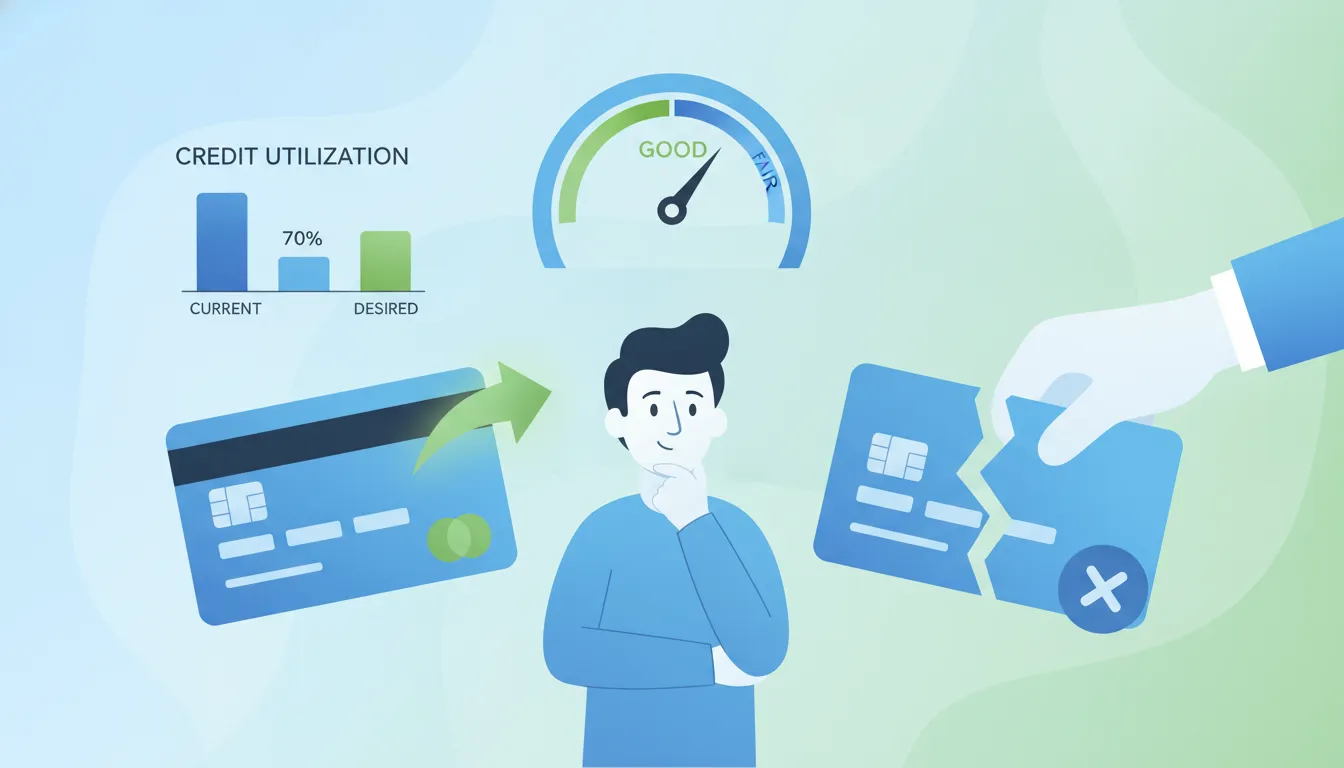
You have a credit card you rarely use. Maybe it charges an annual fee, tempts you to overspend, or simply feels like one more account to manage. Before you cancel it, you want a straight answer: does closing a credit card hurt your credit score?
It can. Closing a card removes its credit limit from your available revolving credit, which may raise your credit utilization ratio. The account’s history does not necessarily disappear immediately, but closing an older account can eventually affect the age of your credit profile. The actual result depends on the rest of your accounts, balances, and credit behavior.
That does not mean every card should stay open forever. A costly or hard-to-control card may be worth closing. The smart approach is to calculate the likely impact, explore alternatives, and close carefully if the benefits outweigh the drawbacks.
Does closing a credit card hurt your credit score?
Closing a credit card can hurt your score, but it does not always cause a large drop. The fastest potential effect usually comes from credit utilization. When the card closes, its limit is no longer available in the calculation. If you carry balances on other cards, the same total debt now represents a larger share of your available credit.
Credit-scoring models consider more than one factor. Payment history, balances, age of accounts, account mix, and recent credit activity may all influence a score. That is why nobody can promise a precise number of points before you close an account. Two people who close cards with identical limits can see different outcomes because their overall credit files differ.
A closed account in good standing may continue appearing on a credit report for years. Therefore, closing an old card does not usually erase its positive history overnight. However, its limit generally stops helping your revolving utilization once the account closes.
Before making the decision, review the key factors that affect your credit score. You can also check your credit reports for free so you know what is currently being reported. If you plan to apply for a mortgage, auto loan, or other major financing soon, avoiding unnecessary changes until after the application may also make sense.
How closing a card changes credit utilization
Credit utilization compares revolving balances with revolving credit limits. It can be measured across all cards and on individual cards. Lower utilization generally signals that you are not heavily dependent on available revolving credit.
A simple utilization example
Suppose you have two credit cards:
- Card A has a $5,000 limit and a $1,000 reported balance.
- Card B has a $5,000 limit and a $0 balance.
Your total balance is $1,000 and your total available limit is $10,000. That creates 10% overall utilization. If you close Card B, the available limit falls to $5,000 while the $1,000 balance remains. Your overall utilization becomes 20%.
You did not add debt, but the percentage doubled because the denominator changed. This is why closing an unused card can affect a credit score even when that card has no balance.
Run the math before you close
Add the reported balances on all open revolving accounts. Then divide that total by the combined limits of those accounts. Repeat the calculation after subtracting the limit of the card you may close. This comparison shows whether closure is likely to create a meaningful utilization increase.
Remember that the balance reported to the credit bureaus may be the statement balance, not the current balance you see after making a recent payment. Learn more about the impact of credit utilization before timing the closure.
If the post-closure ratio would be much higher, consider paying down other card balances first. You can also ask whether the issuer offers a no-fee product change that preserves the account and limit. Avoid opening a new card solely to replace the limit without considering the new inquiry, new account, and temptation to spend.
What happens to the age of your credit history?
People often assume that closing a credit card instantly deletes its history. That is usually not how credit reporting works. A closed account in good standing may remain on your reports for years and can continue contributing information to scoring models while it appears.
The longer-term issue is what happens after the closed account eventually falls off a report. If it was one of your oldest accounts, its removal could shorten the age of your reported credit history. The effect depends on the ages of your remaining accounts and the scoring model being used.
Oldest account versus average account age
Credit age is not a single measurement. Scoring models may consider factors such as the age of your oldest account, the average age of accounts, and how long specific accounts have been open. Closing a newer card may present less age-related concern than closing your only long-established revolving account.
Still, age should not be the only reason to keep a card. If an old account charges an expensive fee or creates a serious overspending risk, the practical benefit of closure may be more important than preserving credit age. Good financial decisions support the whole picture, not just a score.
When should you keep or close a credit card?
The right choice balances credit effects with real costs and behavior. Keeping a no-fee card open can preserve available credit. Closing a costly or difficult-to-manage card can simplify your finances and reduce risk.
| Situation | Option to consider | Why |
|---|---|---|
| No annual fee, no overspending concern, and an older account | Keep open | The limit may help utilization and the account may support credit age. |
| Annual fee no longer delivers enough value | Ask about a product change, then consider closing | A no-fee downgrade may preserve the account without the recurring cost. |
| Card makes overspending difficult to control | Close or restrict access | Protecting your finances can matter more than a possible score effect. |
| Card has poor terms and no useful benefits | Compare alternatives before closing | You may be able to switch products while preserving the account history. |
| Major loan application is approaching | Consider waiting | Avoiding optional credit-profile changes may simplify the application period. |
| Card is lost, compromised, or subject to fraud | Contact the issuer immediately | Security comes first; replacement may be possible without closing the account. |
Good reasons to keep the card
- It has no annual fee and helps keep overall utilization lower.
- It is one of your oldest accounts and is easy to manage responsibly.
- It provides useful benefits without encouraging extra spending.
- The issuer allows you to lock the card while leaving the account open.
Good reasons to close the card
- The annual fee outweighs the benefits and no suitable downgrade exists.
- Access to the card contributes to recurring overspending or debt.
- You want to simplify accounts and have already considered the utilization effect.
- The issuer has changed the terms in a way that no longer works for you.
There is no universal answer. A credit score is a useful financial tool, but avoiding fees, fraud, and unmanageable debt can be the stronger decision.
Decision checklist before closing a credit card
Use this checklist to replace a quick emotional decision with a clear review.
Compare credit card options with M1 before replacing or closing an account.
- Check the annual fee and benefits. Calculate whether rewards, credits, protections, or other benefits justify the fee. Do not keep paying for value you do not use.
- Review the balance. Closing a card does not eliminate what you owe. Confirm the payoff plan, interest terms, and whether pending charges remain.
- Calculate utilization before and after closure. Subtract the card’s limit from your total available credit and recalculate the percentage using current reported balances.
- Review account age. Identify whether the card is your oldest account or one of several newer accounts. Consider how strong the remaining history is.
- Consider upcoming applications. If a major credit application is near, ask whether this optional change can wait until after financing is complete.
- Ask about a product change. A move to a no-fee card may preserve the account while removing the annual cost. Confirm how the issuer reports the change.
- Move payments and redeem rewards. Update subscriptions, autopay bills, and saved payment methods. Redeem or transfer eligible rewards before they may be forfeited.
If the likely utilization increase is uncomfortable, first focus on paying down revolving balances. The steps to improve your credit score can help you build a broader plan instead of relying on one account decision.
How to close a credit card with less risk
Once you decide that closure is the right move, complete it deliberately. Start by reviewing recent statements for recurring charges, pending transactions, installment plans, and unused rewards. Move every recurring charge to another payment method so an overlooked subscription does not create a missed payment or collection issue.
Pay attention to the remaining balance
A closed card can still have a balance. You remain responsible for payments under the account terms, and interest may continue. Ideally, confirm the exact payoff amount and settle it before closing. If you cannot pay it off immediately, ask the issuer how closure will affect billing and payments.
Contact the issuer and document the request
Call the number on the card or use the issuer’s secure support channel. Ask one last time whether a no-fee product change is available if cost is the reason for leaving. If you proceed, request confirmation that the account was closed at your request and keep the confirmation for your records.
Afterward, monitor your statements until the balance is zero and no new charges appear. Review your credit reports later to confirm the account status is accurate. Destroy the physical card after closure, but retain relevant records.
Alternatives to closing an unused credit card
Closing is not the only way to solve an unused-card problem. The best alternative depends on whether your concern is cost, clutter, security, or spending behavior.
Request a no-fee product change
If an annual fee is the main problem, ask the issuer about moving to a no-fee card. Confirm whether the card number, credit limit, account opening date, rewards, and reporting will change. Do not assume every product change works the same way.
Lock the card or remove it from easy access
Many issuers let cardholders lock new purchases temporarily. You can also remove the card from digital wallets and online merchant accounts. These steps may reduce casual spending while preserving the open account. They are not a substitute for closure when access creates a serious financial risk.
Keep a small recurring bill on the card
An issuer may close a card after long inactivity. A small predictable bill with automatic full payment can keep an account active, but this strategy requires monitoring. Check statements and alerts every month. Autopay can fail, card details can be compromised, and a forgotten charge can still create problems.
Do not lower the credit limit without running the same utilization calculation you would use for closure. A lower limit can also increase your utilization ratio. Whatever option you choose, prioritize on-time payments and manageable balances.
Get clear, practical credit guidance from M1 Credit Solutions before making your next move.
Frequently asked questions
How many points will my score drop if I close a credit card?
There is no fixed point loss. The effect depends on the closed card’s limit, your balances, your remaining available credit, account ages, and the scoring model. Calculate utilization before and after closure to estimate the most immediate risk.
Is it better to close a credit card or leave it open with a zero balance?
Leaving a no-fee card open may help preserve available credit, but only if you can monitor it and avoid overspending. Closing may be better when the card costs too much, creates risk, or complicates your finances.
Does closing a card remove late payments?
No. Closing an account does not erase accurate negative history or eliminate a balance. Continue making every required payment and review your reports for accuracy.
Should I close a card before applying for a mortgage?
Optional credit changes shortly before a major application can add uncertainty. Consider waiting and speak with your lender about your specific situation before changing accounts.
Can an issuer close an unused card?
Yes, an issuer may close an inactive account. Monitor communications and consider occasional responsible use if preserving the account is important to you.
Make the next credit-card decision with confidence
Closing a credit card can affect utilization quickly and credit age over time, but keeping every card open is not always the best financial choice. Run the numbers, consider fees and spending behavior, and explore a product change before deciding.
Explore M1 Credit Solutions resources to take the next step with a clearer view of your credit profile.