
Your personal credit score and your business credit score are two completely different things, and most entrepreneurs never bother to build the second one. That is a costly mistake. A strong business credit profile lets you qualify for larger loans, negotiate better payment terms with suppliers, and protect your personal assets from business liabilities. It separates you, the individual, from your company. Founders who need revolving access early in the process can also review our guide to secured business credit cards for a practical starter option. For purchasing equipment, explore our equipment financing options.
Ready to Start Building Your Business Credit?
M1 Credit Solutions gives you AI-powered tools and step-by-step guidance to build a strong business credit profile from scratch.
The problem is that business credit does not build itself. Unlike personal credit, which accumulates automatically through your spending habits, business credit requires a deliberate, strategic approach. You need to know which bureaus track your company, which vendors report your payments, and how to structure your financial activity so it actually counts.
This guide breaks the entire process into clear, actionable steps. Whether you are launching a new LLC or have been operating for years without a business credit profile, you will learn exactly how to build business credit from the ground up and keep it growing. If you are just starting out, see our guide on establishing business credit for a new business for a targeted approach.
- Separate your business legally. Register as an LLC or corporation, get an EIN, and open a dedicated business bank account before applying for any credit.
- Open vendor accounts that report to credit bureaus. Net 30 trade lines with reporting vendors are the foundation of your business credit profile.
- Monitor all three bureaus. Dun & Bradstreet, Experian Business, and Equifax Business each score your company differently. Track all three.
- Pay early, not just on time. Early payments accelerate your PAYDEX score and signal low risk to lenders.
- Use the right tools. M1 Credit Solutions provides AI-powered credit analysis and step-by-step business credit building guidance in one platform.
For a quick-start version, follow these 7 simple steps to build business credit and get your profile up and running fast.
What Is Business Credit and Why Does It Matter?
Business credit is a financial profile tied to your company’s Employer Identification Number (EIN), not your Social Security Number. Three major bureaus track and score your business credit: Dun & Bradstreet (D&B), Experian Business, and Equifax Business. Each bureau uses its own scoring model, and lenders, suppliers, and insurers check one or more of them before deciding whether to do business with you. Government-backed SBA loans are one of the most accessible funding options once you establish strong business credit.
Here is why it matters in practical terms:
- Access to larger funding. Business credit scores directly influence your approval odds and credit limits for business loans, lines of credit, and credit cards. A strong profile can unlock six- and seven-figure funding that personal credit alone cannot support.
- Better interest rates and terms. Companies with established business credit consistently receive lower interest rates and longer repayment terms. Over the life of a loan, this can save you tens of thousands of dollars.
- Separation of personal liability. When your business has its own credit profile, lenders and vendors evaluate your company on its own merits. This protects your personal savings, home, and other assets if your business faces financial difficulty.
- Vendor and supplier leverage. Suppliers often extend Net 30, Net 60, or Net 90 payment terms to businesses with good credit. That means you can receive inventory or services now and pay later, improving your cash flow.
- Lower insurance premiums. Many commercial insurers check business credit scores when setting premiums. A stronger profile can reduce your operating costs.
The bottom line: building business credit is not optional if you are serious about scaling your company.
If you have formed an LLC, our dedicated guide on establishing business credit for your LLC covers the specific steps and vendor accounts that align with LLC structures.
How Business Credit Scores Work: Bureau by Bureau
Understanding how each bureau scores your business is essential. They do not all use the same scale, and they do not all weigh the same factors.
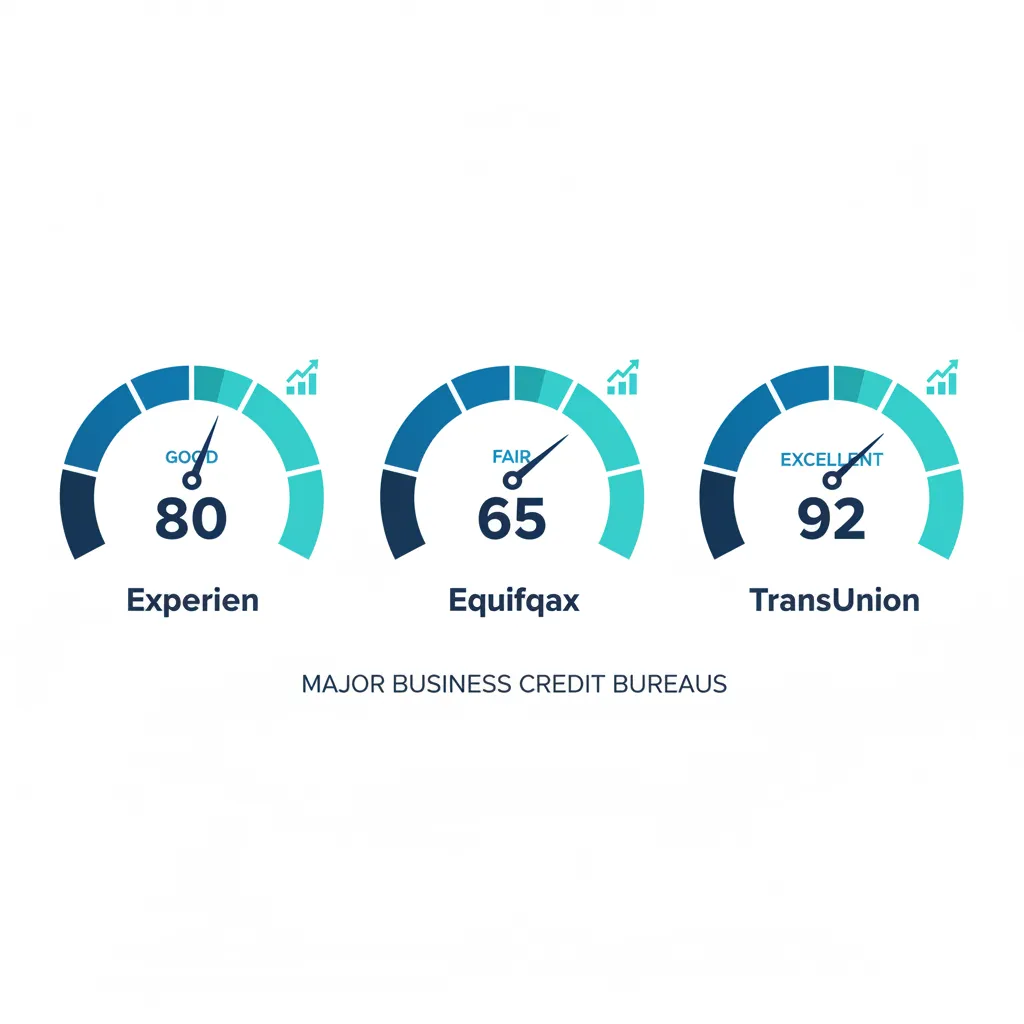
Dun & Bradstreet PAYDEX Score
The PAYDEX score is the most widely recognized business credit score. It ranges from 1 to 100, and it measures how promptly your business pays its bills. A score of 80 or above is considered good, meaning you pay on time or early.
Key details:
- Based entirely on your payment history with vendors who report to D&B
- Requires a D-U-N-S Number (free to obtain from D&B)
- A score of 100 means you consistently pay early
- Does not factor in the size of your credit lines or your industry
Experian Business Intelliscore Plus
Experian’s Intelliscore Plus ranges from 1 to 100 and evaluates your business’s likelihood of becoming seriously delinquent on payments within the next 12 months. A score of 76 or higher is considered low risk.
Key details:
- Considers payment history, credit utilization, company size, and industry risk
- Factors in both business and personal credit information for smaller businesses
- Updates as vendors, lenders, and financial institutions report data
- Widely used by banks and commercial lenders
Equifax Business Credit Risk Score
Equifax’s business score ranges from 101 to 992, with higher scores indicating lower risk. This score evaluates your company’s payment performance and public record information.
Key details:
- Incorporates payment history, liens, judgments, and bankruptcy filings
- Considers the age of your oldest financial account
- Weighted toward recent payment behavior
- Used by both lenders and suppliers for risk assessment
Knowing which bureaus your vendors and lenders check helps you focus your efforts where they will have the most impact.
Step 1: Establish Your Business as a Legal Entity
Before you can build business credit, your company needs to exist as a separate legal entity. Sole proprietorships and general partnerships commingled with personal finances make it nearly impossible to build a distinct business credit profile.
What to do:
- Register your business. Form an LLC or corporation through your state’s Secretary of State. This creates the legal separation between you and your company.
- Get an Employer Identification Number (EIN). Apply for a free EIN from the IRS at irs.gov. This is your business’s equivalent of a Social Security Number and is required for virtually every credit application.
- Open a dedicated business bank account. Use your EIN and business formation documents to open a checking account in your company’s name. Never mix personal and business finances; this is the foundation for learning how to separate business and personal credit.
- Get a dedicated business phone number. List it with directory assistance. Credit bureaus and lenders verify business legitimacy through phone listings.
- Set up a professional business address. A physical address (not a P.O. Box) adds credibility. If you work from home, consider a virtual office address.
This foundation is non-negotiable. Without it, credit bureaus have no way to create a profile for your company.
Step 2: Get Your D-U-N-S Number
Your D-U-N-S Number is a nine-digit identifier assigned by Dun & Bradstreet. It is the key that unlocks your D&B credit file, and many lenders, government agencies, and suppliers require it.
How to get one:
- Visit the Dun & Bradstreet website and request your number for free
- The standard process takes about 30 business days
- Expedited options are available for a fee
Once you have your D-U-N-S Number, your business credit file with D&B is officially open. Every payment reported to D&B from this point forward contributes to your PAYDEX score.
Step 3: Open Vendor Credit Accounts (Net 30 Trade Lines)
Vendor credit accounts, also called trade lines, are the engine that builds your business credit. These are accounts with suppliers who extend you payment terms (typically Net 30, meaning you have 30 days to pay) and then report your payment activity to one or more business credit bureaus.
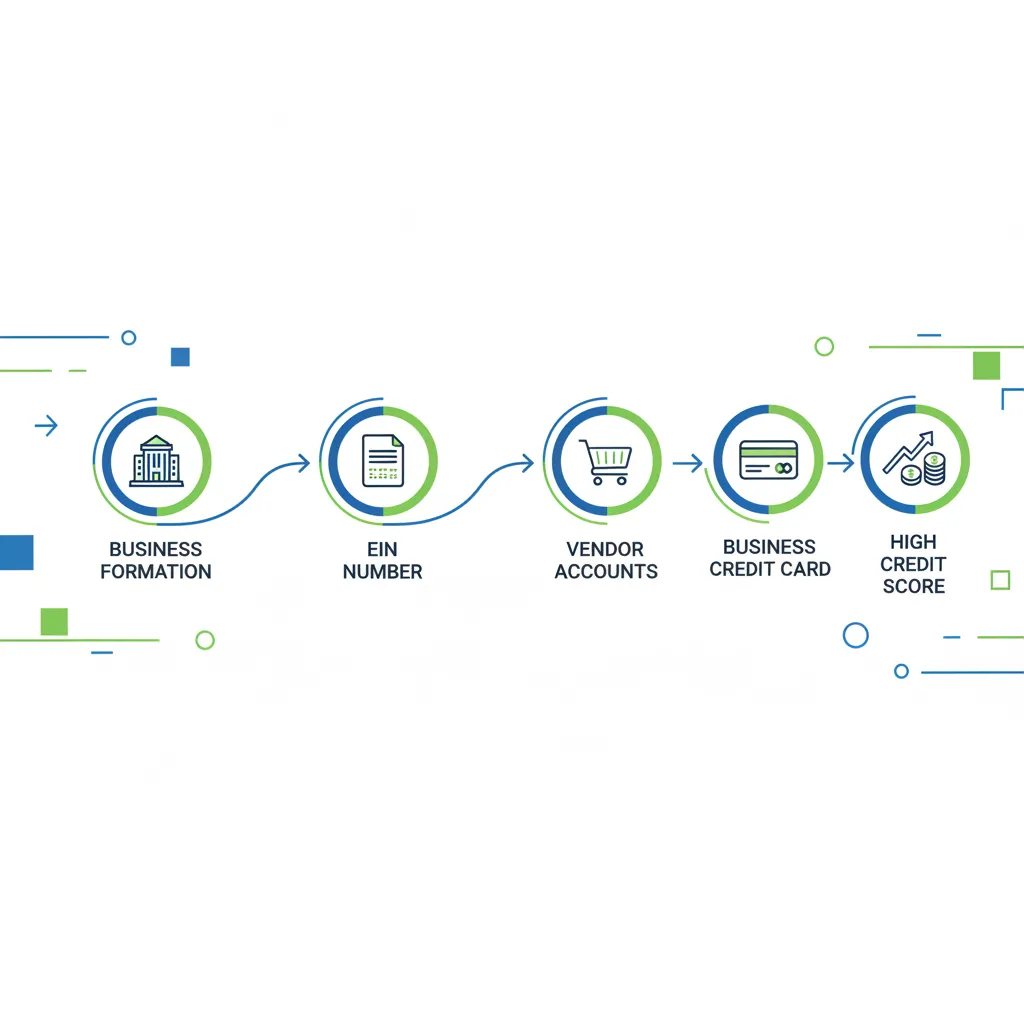
Best Starter Vendors for New Businesses
Not every vendor reports to business credit bureaus. Focus on those that do:
- Office supply companies that offer Net 30 accounts to new businesses
- Shipping and logistics providers with business accounts
- Fleet fuel card providers that report to D&B and Experian
- Technology and software vendors with Net 30 payment options
- Industrial and janitorial supply companies with business trade credit
For a detailed list of vendors that report to business credit bureaus, read our guide to the best net 30 vendor accounts for building business credit.
The Timeline
Here is a realistic timeline for how vendor credit translates into a score:
| Timeframe | Milestone |
|---|---|
| Month 1-2 | Open 3-5 vendor accounts, make small purchases |
| Month 3-4 | First payment histories appear on credit reports |
| Month 5-6 | PAYDEX score begins to generate (requires 3+ trade lines) |
| Month 7-12 | Score strengthens as payment history deepens |
| Year 2+ | Qualify for larger credit lines, bank loans, and premium terms |
The key is consistency. Pay every invoice on time or early. A single late payment can set your progress back significantly.
Step 4: Get a Business Credit Card
A business credit card serves two purposes: it gives you flexible purchasing power, and it adds another trade line that reports to credit bureaus. Many business credit card issuers report to both personal and business credit bureaus, so this is one of the fastest ways to build your profile.
Tips for choosing the right card:
- Look for cards that report to all three business credit bureaus
- Secured business credit cards are available if you have limited or bad personal credit
- Keep your utilization below 30% of your credit limit
- Pay the full balance each month to avoid interest charges and demonstrate responsible use
If you are forming a new LLC, check out our list of the best business credit cards for new LLCs to find the right fit.
Step 5: Monitor Your Business Credit Reports
You cannot manage what you do not measure. Regularly checking your business credit reports ensures that your payments are being reported correctly and that no errors are dragging down your scores.
What to check:
- Verify all trade lines are reporting to the correct bureaus
- Look for errors in payment dates, amounts, or account details
- Check for any negative items such as liens, judgments, or collections
- Confirm your business name, address, and EIN are consistent across all reports
If you find errors, dispute them directly with the reporting bureau. Inaccurate negative items can significantly damage your scores and should be addressed immediately.
This is where tools like M1 Credit Solutions become particularly valuable. M1’s AI-powered platform can connect to your credit reports, automatically identify negative or inaccurate items, and generate customized dispute letters designed to get them corrected. Instead of spending hours deciphering credit report codes and writing dispute letters from scratch, you get a clear, automated system that handles the heavy lifting.
Step 6: Build Business Credit Without Relying on Personal Credit
One of the most common questions entrepreneurs ask is how to build business credit without using personal credit. The good news is that it is entirely possible, but it requires a deliberate approach.
Here is the strategy:
- Start with vendor credit. Vendor accounts that require only an EIN (no personal guarantee) are your starting point. These build your business credit profile independently of your personal score.
- Use a secured business credit card. Secured cards require a cash deposit instead of a personal credit check. The deposit becomes your credit limit, and your payments build your business credit.
- Avoid personal guarantees when possible. As your business credit strengthens, you will qualify for more products that do not require a personal guarantee. This is the goal: building business credit without a personal guarantee so your personal assets stay protected.
- Incorporate as an LLC or corporation. This legal separation is what makes it possible to build business credit independently. Without it, your personal and business finances are intertwined.
If you are starting from scratch with limited personal credit, this process takes more time but is absolutely achievable. M1 Credit Solutions offers step-by-step business credit building tools that guide you through each stage, from entity formation to your first vendor accounts.
Step 7: Maintain and Grow Your Business Credit
Building business credit is not a one-time project. It requires ongoing management to keep your scores strong and your profile growing.
Best practices for maintaining strong business credit:
- Always pay early or on time. This is the single most important factor across all three bureaus. Set up payment reminders or automatic payments to ensure you never miss a due date.
- Keep credit utilization low. Use less than 30% of your available credit across all accounts. High utilization signals financial stress to credit bureaus and lenders.
- Gradually increase your trade lines. As your scores improve, apply for additional vendor accounts and credit products. A diverse mix of credit types strengthens your profile.
- Update your business information. Keep your company name, address, phone number, and industry codes consistent across all bureaus and business listings. Inconsistencies can cause reporting issues.
- Review reports quarterly. Check all three bureau reports at least every quarter to catch errors early and track your progress.
If you want to take your scores to the next level, our guide on how to improve your business credit score covers advanced strategies for maximizing your ratings.
Common Mistakes That Kill Your Business Credit
Knowing what not to do is just as important as knowing the right steps. These mistakes are common and can derail your progress:
1. Mixing Personal and Business Finances
Using your personal bank account or credit card for business expenses makes it impossible for credit bureaus to track your business activity separately. Always keep a clear wall between the two.
2. Not Checking Which Vendors Report
Many vendors accept business payments but do not report to credit bureaus. If a vendor does not report, your on-time payments do nothing for your business credit score. Always confirm reporting practices before opening an account.
3. Applying for Too Much Credit at Once
Each credit application can trigger an inquiry. Too many inquiries in a short period signals desperation to lenders and can temporarily lower your scores.
4. Ignoring Your Business Credit Reports
Errors on business credit reports are more common than most entrepreneurs realize. An incorrect late payment or a misattributed collection account can significantly damage your scores. Monitor your reports regularly and dispute any inaccuracies.
5. Letting Accounts Go Inactive
If you stop using a vendor account, that vendor may stop reporting your payment history. Keep your accounts active with regular, small purchases to maintain consistent reporting. For more details, see our guide on business line of credit.
How Long Does It Take to Build Business Credit?
This is one of the most frequently asked questions, and the honest answer is: it depends on how consistently you follow the process.
Here is a general timeline:
- 30-60 days: Your business entity is established, you have your EIN and D-U-N-S Number, and your first vendor accounts are open.
- 3-6 months: Initial payment histories appear on your credit reports. Your PAYDEX score begins to generate once you have at least three reporting trade lines.
- 6-12 months: With consistent on-time payments, your scores reach “good” territory (PAYDEX 70-80+).
- 12-24 months: A solid credit profile qualifies you for bank loans, larger lines of credit, and premium vendor terms without a personal guarantee.
The most important thing is to start now. Every month you wait is a month of payment history you are missing. The process is straightforward, but it rewards consistency over speed.
How M1 Credit Solutions Helps You Build Business Credit
Building business credit can feel overwhelming when you are managing it alongside everything else that comes with running a business. That is exactly why M1 Credit Solutions exists.
M1’s platform gives you the tools to take control of both your personal and business credit from one place:
- AI-powered credit analysis connects to your credit reports from all three major bureaus, identifies negative items, and generates customized dispute letters to help you clean up inaccuracies that could be holding you back.
- Step-by-step business credit building guidance walks you through the entire process, from getting your EIN and D-U-N-S Number to opening your first vendor accounts and monitoring your scores.
- Business lending services connect you with lenders and funding options tailored to your credit profile, industry, and business goals, so you can access capital as your credit grows.
- Real-time dashboard tracks your progress and gives you a clear picture of where you stand at every stage.
Whether you are starting from scratch or looking to strengthen an existing business credit profile, M1 gives you a clear path forward without the guesswork.
Get Started with M1 Credit Solutions →
Frequently Asked Questions
Can I build business credit with bad personal credit?
Yes. Business credit is tied to your EIN, not your SSN. Start with vendor accounts that do not require a personal credit check and use secured business credit cards. As your business credit grows, you will qualify for more products based on your company’s financial history rather than your personal score. You can also use M1’s AI-powered tools to repair your personal credit while simultaneously building your business credit.
How many trade lines do I need to get a business credit score?
Dun & Bradstreet typically requires at least three trade lines reporting payment history before generating a PAYDEX score. Experian and Equifax may generate scores with fewer trade lines, but having at least three to five active, reporting accounts gives you the strongest foundation.
Do business credit cards help build business credit?
Yes, as long as the issuer reports to business credit bureaus. Not all do. Before applying, verify that the card issuer reports to D&B, Experian Business, or Equifax Business. Cards that only report to personal credit bureaus will not help your business credit profile.
Is it possible to build business credit without a personal guarantee?
It is, but it takes time. Start with vendor credit accounts that require only an EIN. As your business credit profile strengthens over 12 to 24 months, you will qualify for credit products that do not require a personal guarantee. Learn more in our guide on building business credit without a personal guarantee.
What is the fastest way to build business credit?
Open multiple vendor accounts that report to credit bureaus, pay every invoice early (not just on time), and get a business credit card. Paying early accelerates your PAYDEX score because D&B rewards prompt payment. You can also read our guide on how to build tier 1 business credit for advanced strategies.
Take the First Step Today
Building business credit is one of the most strategic investments you can make as an entrepreneur. It protects your personal finances, opens doors to better funding, and gives your business the financial credibility it needs to grow.
The process is straightforward, but it rewards action. Every day you delay is a day of payment history you are leaving on the table. Start by establishing your business credit profile today, and let M1 Credit Solutions give you the tools and guidance to make it happen.