
Finding money to grow your business without taking on debt is possible. Small business grants provide free, non-repayable funding from federal, state, local, and private sources. This guide breaks down every type of grant available, who qualifies, and exactly how to apply — so you can fund your next move without a monthly payment.
💡 Your Credit Score Matters — Even for Grants
Most grant applications require financial documentation that reflects your creditworthiness. A stronger credit profile opens more doors — not just for grants, but for every funding option available to your business.
Over $2 billion in small business grant funding is available annually across the United States. Yet most business owners never apply because they don’t know where to look, what they qualify for, or how to submit a winning application.
That changes today. Whether you’re launching a startup, expanding an existing operation, or recovering from a setback, there’s likely a grant program designed for businesses like yours. The key is knowing the landscape and matching your business profile to the right opportunities.
What Are Small Business Grants?
A small business grant is funding awarded to a business that does not need to be repaid. Unlike small business loans, grants are essentially free money — provided you meet the eligibility requirements and use the funds as specified.
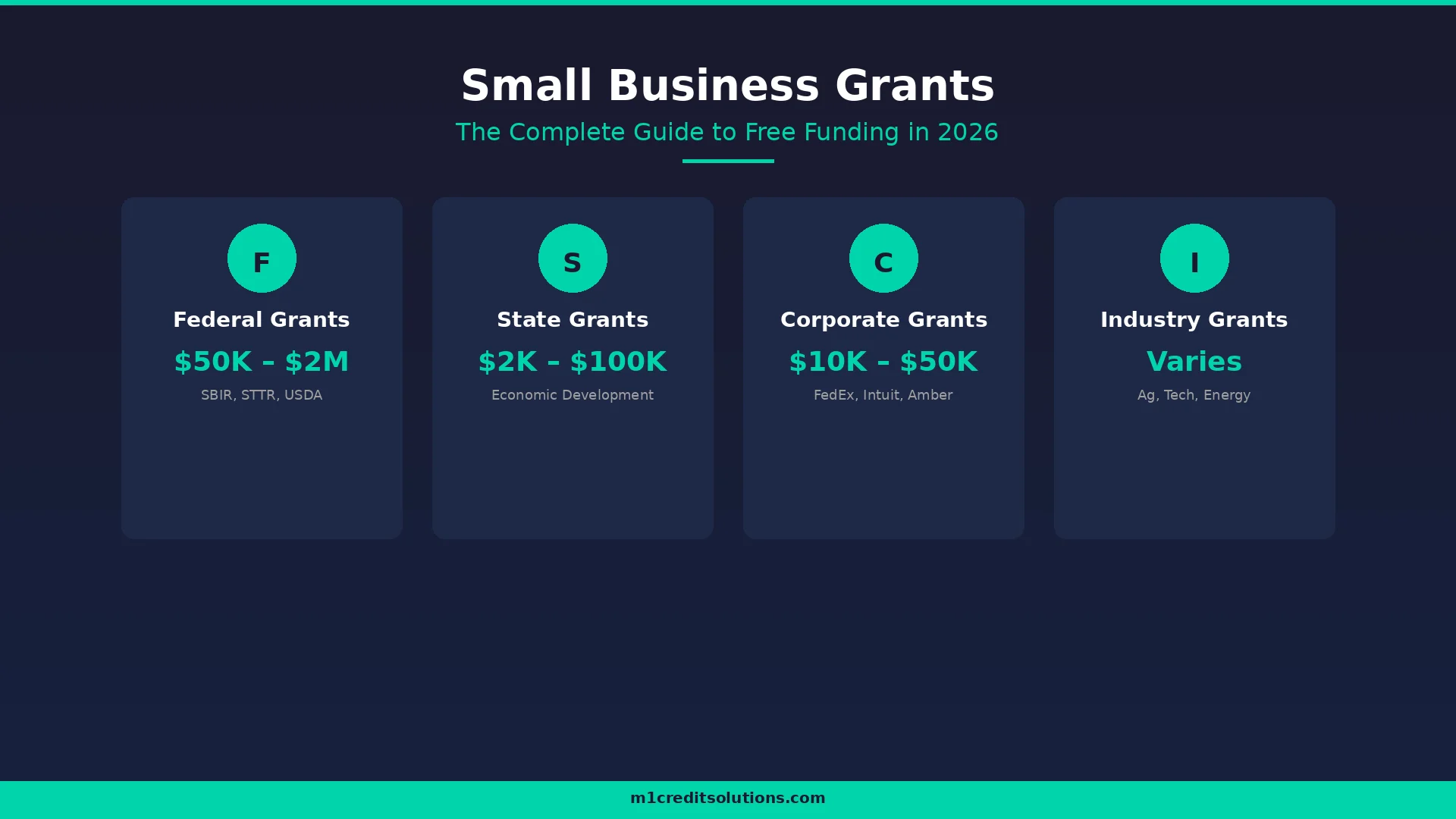
Grants come from four primary sources:
- Federal government agencies (SBA, USDA, NIH, NSF, DOE)
- State and local governments (economic development agencies, city councils)
- Private foundations and nonprofits (community development organizations)
- Corporate grant programs (large companies supporting small business growth)
The tradeoff? Grants are competitive. The SBA estimates fewer than 15% of federal grant applicants receive funding, and some programs see acceptance rates below 5%. Applications require detailed proposals, financial documentation, and clear business plans. But for businesses willing to put in the work, grants represent one of the most valuable funding sources available.
Key Differences Between Grants and Loans
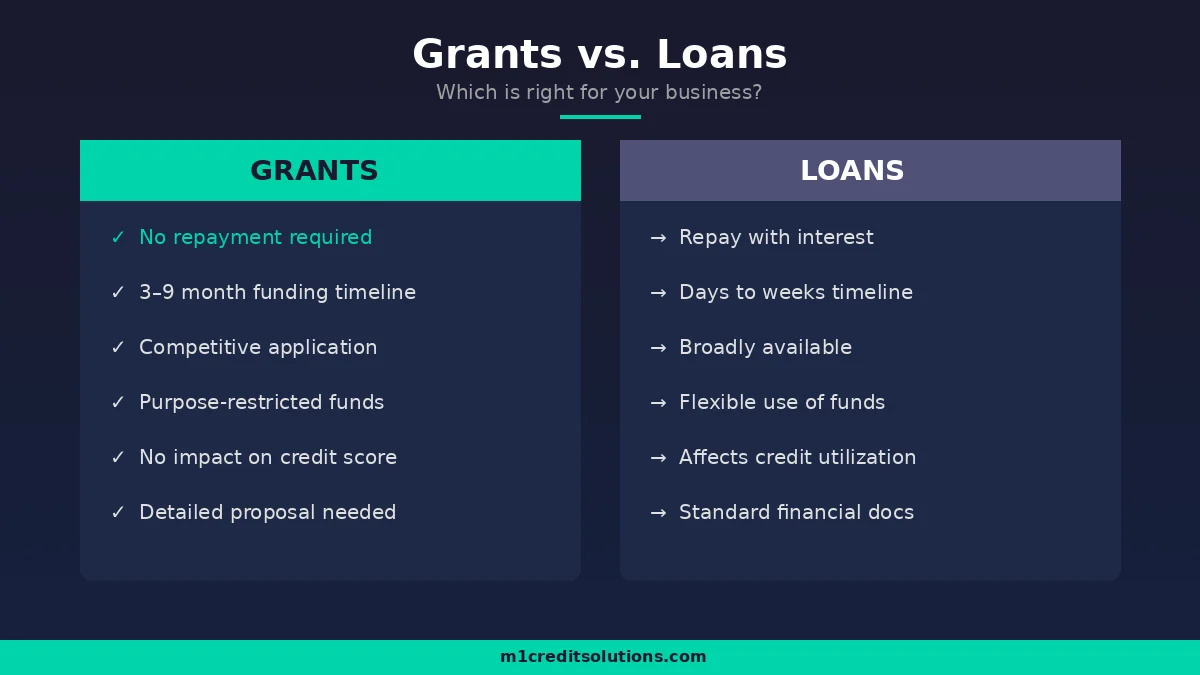
| Feature | Grants | Loans |
|---|---|---|
| Repayment | Not required | Required with interest |
| Application complexity | High — detailed proposals | Moderate — financial documents |
| Funding timeline | 3-9 months typical | Days to weeks |
| Restrictions on use | Specific to grant purpose | Varies by lender |
| Impact on credit | None | Affects credit utilization |
| Availability | Competitive, limited windows | Broadly available |
Understanding this distinction matters. Grants should be part of your funding strategy, but they shouldn’t be your only plan. Smart business owners apply for grants while simultaneously building their credit and exploring startup business loans as backup options.
Types of Small Business Grants
Federal Grants
The federal government is the largest single source of grant funding for small businesses, but here’s what surprises most people: the SBA itself does not provide direct grants for starting or expanding a business. Instead, federal grant dollars flow through specific agencies and programs designed to support innovation, research, and economic development.
Small Business Innovation Research (SBIR)
The SBIR program is the crown jewel of federal small business grants. Eleven federal agencies participate, collectively awarding over $4 billion annually. The program operates in phases:
- Phase I: $50,000 to $275,000 for proof-of-concept research (6-12 months)
- Phase II: $500,000 to $2 million for full R&D development (up to 2 years)
- Phase III: Commercialization stage with preferential treatment for federal contracts
Your project must involve scientific or technical innovation to qualify. A restaurant concept won’t work, but food safety technology, agricultural systems, or biotech solutions could.
Small Business Technology Transfer (STTR)
Similar to SBIR but requires a formal partnership with a research institution (university or federal lab). Award amounts mirror SBIR, and the program is ideal for businesses developing technology alongside academic partners.
USDA Rural Business Development Grants
If your business operates in a rural area (population under 50,000), the USDA offers grants ranging from $10,000 to $500,000. These funds support technical assistance, training, and business development in rural communities.
Community Development Financial Institutions (CDFI) Fund
The CDFI Fund supports certified lenders serving low-income communities. While the money flows through intermediaries rather than directly to businesses, CDFI-backed organizations provide grants, microloans, and technical assistance to underserved entrepreneurs.
State and Local Grants
State grants fly under the radar because there’s no single national directory. Each state runs its own programs through different agencies, with different names, funding cycles, and eligibility requirements. That fragmentation is exactly why state grants are less competitive than federal programs — fewer applicants find them.
Where to look:
- Your state’s Department of Commerce or Economic Development Agency
- City or county small business offices
- Regional development organizations
- State SBDC (Small Business Development Center) offices
Typical state grant amounts: $2,000 to $100,000, depending on the program and state.
Examples of active state programs:
- California Dream Fund: Up to $10,000 for underserved small businesses
- Texas Enterprise Fund: Negotiated deals for job-creating businesses
- New York Forward Loan Fund: Low-interest and grant-hybrid programs
- Florida microenterprise grants: City-level programs typically $5,000 to $25,000
Many state programs specifically target businesses that create local jobs, support community development, or operate in priority industries like clean energy, manufacturing, or agriculture.
Private and Corporate Grants
Private grants come from corporations, foundations, and nonprofit organizations. They tend to have simpler application processes than government grants and faster funding timelines.
Notable corporate grant programs:
- Intuit QuickBooks Small Business Hero Program: $20,000 grants for businesses demonstrating courage and perseverance
- FedEx Small Business Grant Contest: Awards ranging from $15,000 to $50,000
- Amber Grant Foundation: Monthly $10,000 grants for women-owned businesses, plus a $25,000 annual award
- NAACP x Fearless Fund: Grants supporting Black-owned businesses
- Hello Alice Small Business Growth Fund: Various grant amounts for diverse entrepreneurs
Pro tip: Corporate grants often require a strong story and community impact narrative. Your business plan matters, but so does your ability to articulate why your business matters to the community.
Industry-Specific Grants
Certain industries have dedicated grant funding that general small business owners often overlook:
- Agriculture: USDA grants for farmers, ranchers, and food-related businesses
- Clean energy: Department of Energy grants for renewable and efficiency projects
- Technology: NSF grants for scientific and tech innovation
- Healthcare: NIH grants for biomedical and health technology research
- Manufacturing: SBA Manufacturing Initiative grants for workforce development
- Exporting: State Trade Expansion Program (STEP) grants for businesses entering international markets
Grants for Minority, Women, and Veteran Business Owners
Several grant programs specifically target underrepresented business owners. These programs exist to level the playing field and often have less competition than general programs.
Grants for Women-Owned Businesses
- Amber Grant Foundation: $10,000 monthly grants plus a $25,000 year-end award. One of the longest-running women’s grant programs.
- IFundWomen Universal Grant Database: Curated list of grants specifically for women entrepreneurs
- SBA Women’s Business Centers (WBCs): While not direct grants, WBCs provide counseling, training, and connections to funding
- Cartier Women’s Initiative: International program offering $100,000 awards to women-led impact businesses
- Tory Burch Foundation Fellows Program: Grants and mentorship for women entrepreneurs
Grants for Minority-Owned Businesses
- National Minority Supplier Development Council (NMSDC): Connects minority businesses with corporate supply chains and grant opportunities
- Minority Business Development Agency (MBDA): Federal programs supporting minority entrepreneurs through business centers nationwide
- First Nations Development Institute: Grants for Native American-owned businesses and community projects
- National Urban League: Entrepreneurship grants and business development programs
Grants for Veteran-Owned Businesses
- SBA Boots to Business Program: Entrepreneurship training and connections to veteran-specific funding
- StreetShares Foundation: Awards for veteran entrepreneurs, including the Veteran Small Business Award
- Bob Woodruff Foundation: Grants supporting veteran-owned businesses and their families
- Hivers and Strivers: Angel investment and grants for veteran entrepreneurs
If you’re a veteran exploring business funding, our veteran business loan guide covers additional financing options beyond grants.
How SBA Grants and Programs Work
There’s a common misconception that you can walk into an SBA office and apply for a business grant. That’s not how it works.
What the SBA actually does with grants:
- Research grants (SBIR/STTR): The SBA coordinates these programs across 11 federal agencies. The grants fund scientific research and development with commercial potential.
- Community organization grants: The SBA provides grants to nonprofits, Small Business Development Centers, and educational organizations that support entrepreneurship through counseling and training.
- Manufacturing grants: Part of the Made in America initiative, these grants fund training and workforce development for small manufacturers.
- Export grants (STEP): Financial awards to state governments to help small businesses enter international markets.
What the SBA does NOT do: Provide direct grants for starting or expanding a typical small business. If someone contacts you offering “SBA grants” for your business, verify the email ends in @sba.gov. Grant scams are unfortunately common.
Where the SBA does help directly: The SBA’s primary value for most small businesses is through guaranteed loans, counseling, and training programs. If you need capital faster than grants allow, explore SBA-backed loan options that provide favorable terms with government backing.
How to Find Small Business Grants
Knowing grants exist is only half the battle. Here’s where to actually find them:
Federal Grant Databases
- Grants.gov: The most comprehensive federal grant database. Search by keyword, agency, eligibility, or funding amount. Set up email alerts for new opportunities in your category.
- SAM.gov: System for Award Management — register here before applying to any federal grant. Registration is free and required.
- SBIR.gov: Dedicated portal for SBIR and STTR opportunities across all participating agencies.
State and Local Resources
- Your state’s economic development website: Every state has one. Search “[your state] small business grants” or “[your state] economic development agency.”
- SBDC Locator (americassbdc.org): Find your nearest Small Business Development Center for free counseling and grant guidance.
- Local chamber of commerce: Often aware of city and county-level grant programs.
Private Grant Directories
- GrantWatch.com: Aggregates grants from multiple sources (subscription required for full access).
- Hello Alice: Free platform matching businesses with relevant grant opportunities.
- Grants.gov community forums: Connect with other grant seekers and share leads.
Staying Current
Grant programs open and close regularly. The most effective approach is to:
- Set up Grants.gov email alerts for your industry and business type
- Check your state economic development website monthly
- Follow organizations like the U.S. Chamber of Commerce and SBA on social media for announcements
- Join local business networks that share grant opportunities
How to Apply for Small Business Grants: Step-by-Step
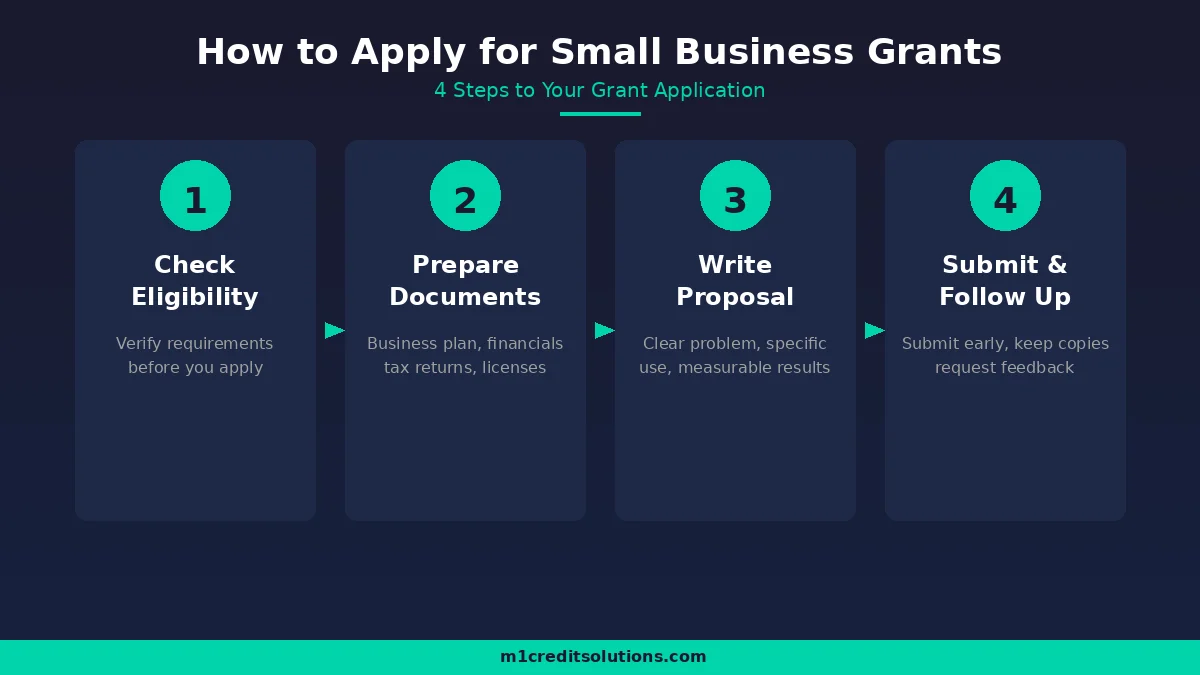
Step 1: Assess Your Eligibility
Before spending hours on an application, verify you meet the basic requirements:
- Business registration: Is your business legally registered (LLC, S-Corp, sole proprietorship)?
- EIN/Tax ID: Do you have an Employer Identification Number?
- Size standards: Most federal programs cap at 500 employees under SBA guidelines.
- Location requirements: Does the grant specify a geographic area?
- Industry requirements: Is the grant limited to specific sectors?
- Demographic requirements: Does it target women, minorities, or veterans?
Step 2: Prepare Your Documentation
Gather these documents before you start any application:
- Business plan (current and detailed)
- Financial statements (profit and loss, balance sheet, cash flow)
- Tax returns (typically 2-3 years, both personal and business)
- Business licenses and registrations
- Bank statements (showing cash flow management)
- Resume or bio demonstrating relevant experience
- Project budget (specific to what the grant will fund)
Step 3: Write a Compelling Proposal
Grant proposals that win share these characteristics:
- Clear problem statement: What challenge does your business address?
- Specific use of funds: Exactly how will the money be spent?
- Measurable outcomes: What will change as a result of the funding?
- Community impact: How does your business benefit the broader community?
- Sustainability plan: How will the project continue after grant funding ends?
Step 4: Submit and Follow Up
- Submit before the deadline — ideally 2-3 days early to avoid technical issues
- Keep copies of everything you submit
- Follow up with the grantor after 30 days if you haven’t heard back
- If rejected, request feedback and apply again in the next cycle
Grants vs. Loans: Which Is Right for Your Business?
The honest answer? Most businesses benefit from pursuing both simultaneously.
Choose grants when:
- You have time to wait (3-9 months for funding)
- Your business fits a specific program’s criteria
- You want to avoid debt entirely
- Your project aligns with innovation, research, or community development goals
Choose loans when:
- You need capital quickly (days to weeks)
- You need a large, flexible amount
- Your business doesn’t fit niche grant criteria
- You want to build business credit for future opportunities
The smart approach: Apply for relevant grants while maintaining access to credit and loan options. If a grant comes through, that capital is essentially free. If it doesn’t, you have backup funding ready.
Many successful businesses use a combination strategy — grants for specific projects, loans for working capital, and credit lines for flexibility. If your credit profile needs work before you can access loan products, start with building your business credit to expand your options.
7 Tips for Winning Grant Applications
1. Match Your Project to the Grant’s Mission
Don’t force-fit your business into a grant that doesn’t align. Reviewers can tell immediately when an applicant is stretching. Focus on grants where your business genuinely advances the program’s stated goals.
2. Lead with Data, Not Emotion
“We need money to grow” isn’t compelling. “Our pilot program served 200 customers in 6 months and generated $45,000 in revenue. With $25,000 in grant funding, we project 500 customers and $120,000 in revenue within 12 months” — that’s a winning statement.
3. Get Your Financials in Order
Messy financials are the fastest way to get disqualified. Your books should be clean, current, and prepared by someone who knows what they’re doing. Disorganized finances signal risk to grant reviewers.
4. Start Small
Your first grant application shouldn’t be for a $500,000 SBIR award. Apply to local microgrants ($1,000 to $5,000) first. Build a track record of winning and managing grant funds, then work your way up.
5. Use Free Resources
SBDCs offer free one-on-one counseling, including help with grant applications. SCORE mentors provide volunteer business guidance. These resources exist specifically to help you — use them.
6. Apply to Multiple Programs
Don’t put all your hopes on one application. Apply to several grants simultaneously. The more applications you submit, the better your odds and the sharper your proposal-writing skills become.
7. Build Your Credit While You Wait
Grant timelines are long. While you’re waiting for decisions, strengthen your financial foundation. Repair your credit score and build business credit so you’re positioned for every funding opportunity — not just grants.
🚀 Don’t Wait for a Grant to Start Improving Your Finances
Whether you land a grant or need a loan, your credit score determines your options. M1 Credit Solutions’ AI-powered platform helps you identify and dispute credit report errors — so you’re ready for any funding opportunity that comes your way.
Common Small Business Grant Mistakes to Avoid
Missing deadlines. Grant windows are strict. Mark deadlines on your calendar and submit 2-3 days early. Late applications are never reviewed.
Ignoring eligibility requirements. Read every requirement before starting an application. If you don’t qualify on even one criterion, your application will be rejected regardless of how strong it is.
Vague use of funds. “General business expenses” won’t win a grant. Be specific: “Purchase of commercial-grade oven ($8,500) and point-of-sale system ($3,200) to expand catering operations.”
Skipping the budget. Every proposal needs a detailed, line-item budget. Round numbers ($10,000 for marketing) look lazy. Specific numbers ($9,750 for 6-month digital marketing campaign across Google Ads and social media) look professional.
Not registering on SAM.gov. Federal grants require SAM registration, which can take 2-4 weeks. Register now, even if you’re not ready to apply yet.
Falling for grant scams. Legitimate grants never require an upfront fee to apply. If someone asks you to pay to receive a grant, it’s a scam. The SBA will only contact you from @sba.gov email addresses.
Frequently Asked Questions About Small Business Grants
Do I have to pay back a small business grant?
No. Unlike loans, grants do not require repayment. However, you must use the funds for the specified purpose outlined in your grant agreement. If you misuse grant funds, you may be required to return them.
Can I get a small business grant with bad credit?
Most grants don’t have minimum credit score requirements. However, many applications require financial statements that reflect your overall financial health. Grant reviewers look for financially responsible applicants, so cleaning up your credit report before applying can strengthen your application. M1 Credit Solutions can help you improve your credit before you apply.
How long does it take to receive grant funding?
Federal grants typically take 30 to 90 days from approval to disbursement. State grants vary widely — some pay within 2 weeks, others take 6 months. Corporate grants are usually the fastest, often within 30 days of announcement.
Does the SBA give grants to small businesses?
The SBA does not provide direct grants for starting or expanding a typical business. The SBA does administer SBIR and STTR research grants and provides grants to community organizations, SBDCs, and nonprofits that support small businesses through counseling and training.
Do I have to pay taxes on grant money?
Generally, yes. The IRS treats most grant income as taxable business income. Consult with a tax professional about your specific situation, as some exceptions may apply depending on the grant type and your business structure.
Can I apply for multiple grants at the same time?
Absolutely. There’s no rule against applying to multiple grant programs simultaneously. In fact, it’s recommended. Just be transparent in your applications if a grantor asks whether you’ve applied for other funding.
What are the easiest grants to get?
Local microgrants ($500 to $5,000) from city economic development offices and chambers of commerce tend to be the least competitive. Corporate grants that require a community impact story (rather than a detailed research proposal) also have relatively accessible application processes.
How can I improve my chances of winning a grant?
Focus on grants aligned with your business profile, lead with data and measurable outcomes, get your financial documents organized, use free SBDC counseling for application review, and start with smaller local grants to build a track record before pursuing larger federal awards.
Take the Next Step Toward Funding Your Business
Small business grants are real, accessible, and worth pursuing — but they’re not the only tool in your toolbox. The strongest businesses build multiple funding pathways: grants for specific projects, loans for growth capital, and strong credit profiles that open every door.
Your credit score is the foundation that supports all of these strategies. Whether you’re applying for a grant, negotiating loan terms, or seeking a new line of credit, your financial profile tells funders whether you’re a safe bet.
If your credit needs work, don’t wait. Start building the financial foundation that positions you for every opportunity — grants, loans, and beyond.
Ready to Strengthen Your Financial Profile?
M1 Credit Solutions’ AI-powered platform connects to all 3 credit bureaus, identifies negative items, and generates custom dispute letters — so you can focus on growing your business.