

— A single late payment on your credit history can drop your FICO score by up to one hundred points. This sudden drop makes it much harder to get a home loan or low interest rates. Fortunately, you can take action to clean up your credit profile.
Ready to check your credit? Start your M1 Credit Solutions journey today and see your credit score for free.
To remove late payments from credit report files, first check if the entry is accurate or an error. If inaccurate, file a dispute with the credit bureaus. If accurate, write a goodwill letter to your creditor or negotiate a pay-for-delete agreement. Under the FCRA, late payments automatically fall off your credit report after seven years from the original delinquency date.
Many people struggle to understand how these negative marks hit their credit standing. The next section explores How Late Payments Affect Your Credit Score so you can see exactly what is at stake. Learn how to protect your score and repair the damage.
Remove Late Payments From Credit Report: How Late Payments Affect Your Credit Score
Your payment history is the single most important factor for both your personal and business credit scores. In fact, payment history makes up 35% of your FICO score. When you miss a payment, it can lead to a quick and sharp drop in your overall score. Knowing how these late marks affect you can help you protect your financial health.
The Severity of the Delay
Lenders look at how late you are to pay your bills. A payment is not marked as late on your credit report until it is at least 30 days past due. If you pay within that 30-day window, you may face a late fee from your creditor, but your credit score will not drop. Once the delay passes 30 days, the creditor can report it to the credit bureaus.
The damage to your score gets worse at 60 days, and it drops even more once you hit 90 days past due. A single payment that is 90 days late does much more harm than one that is 30 days late. If your score is not where you want it to be, you should look at your overall history. Find out why is my credit score not improving so you can start to fix the root causes of the issue.
The Impact of a Pattern
One late payment is bad, but a pattern of late payments is much worse. Lenders look at your credit report to see how you manage your debt over time. If they see that you are often late, they will view you as a high-risk borrower. This can make it hard to get new loans or credit cards in the future.
A single late payment can stay on your credit report for up to seven years. During this time, it will continue to drag your score down, though the impact will fade over the years. To get your score back on track, you may need to learn how to dispute credit report errors with the CFPB files if the marks are not correct. Keeping your payments on time is the best way to build trust with lenders.
Bottom line: Missed payments can cause immediate and long-term damage to your credit score because they make up more than a third of your FICO score. You should focus on paying your bills within the 30-day grace period to avoid a major drop in your credit health. M1 Credit Solutions provides AI-driven tools to help you track and improve your payment history over time.
How Long Do Late Payments Stay on Your Credit Report?
A late payment can have a big effect on your credit score. If you pay your bill late, the negative mark does not stay on your report forever. Under federal law, most negative credit information can only be reported for up to seven years. Knowing how this timeline works can help you make a plan to improve your credit score and clear your record.
Bottom line: Late payments can only stay on your credit reports for up to seven years under federal rules before they must be removed. M1 Credit Solutions helps you monitor your credit timeline so you know when negative marks should fall off.
The Seven-Year Credit Reporting Clock
The clock for a late payment starts on the date of the first missed payment. This date is known as the original delinquency date. The Consumer Financial Protection Bureau (CFPB) monitors companies to ensure they report these dates accurately. Once seven years pass from that date, the credit bureaus must remove the late payment from your credit report. If you want to explore automated credit repair tools files before then, you can only do so if the mark is inaccurate.
Bottom line: The seven-year timeline starts from your original delinquency date, and bureaus must delete the record once this time is up.
How Creditors Report Late Payments
Lenders do not report a payment as late the very day you miss a due date. If you pay within 30 days of the due date, the late payment will generally not show up on your credit reports, according to Equifax. However, once a bill is 30 days or more overdue, creditors will report the late payment to the credit bureaus. Chase notes that credit card issuers typically report late payments once they hit this 30-day mark.
Bottom line: Payments that are less than 30 days late are not reported to the credit bureaus and will not hurt your credit score.
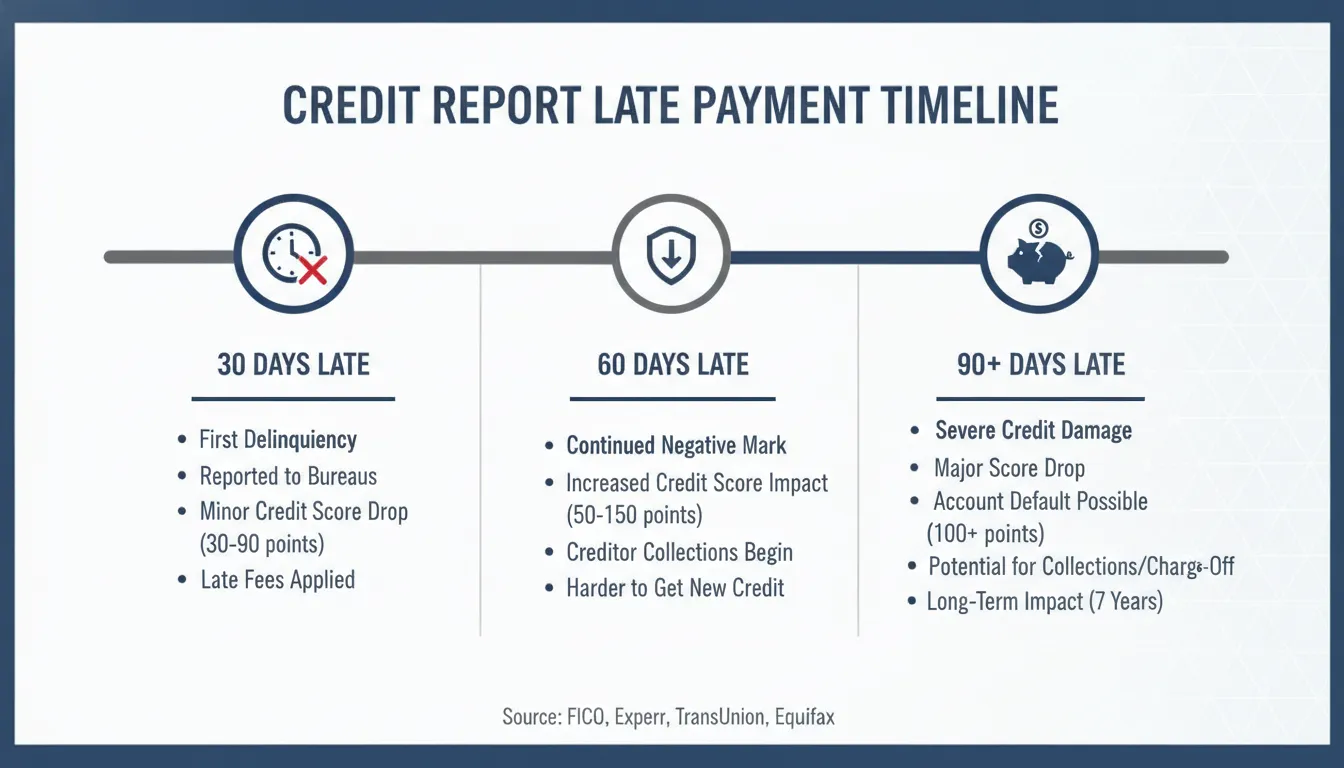
The Severity of Late Payment Tiers
Your credit report tracks past-due accounts in 30-day steps. These steps are 30, 60, 90, and 120 days late. Each tier shows a higher level of risk to lenders. A 30-day late payment hurts your score, but a 90-day late payment does much more damage. If you do not pay for a long time, the creditor may sell your debt to a collection agency. This can lead to a duplicate account on credit report files, which hurts your score even more.
Bottom line: Late payments grow more damaging in 30-day steps, and very late debts can lead to severe collection accounts.
Can You Remove Accurate Late Payments With a Goodwill Letter?
Most negative marks must stay on your credit file for a set time. Under federal guidelines, accurate negative items can remain for up to seven years. The Consumer Financial Protection Bureau (CFPB) confirms that credit bureaus can report true details for this full period. But you can still ask a creditor to remove a minor mistake if you have a good reason.
A goodwill letter is a formal request to your creditor to delete an old slip. You do not dispute the fact that you paid late. Instead, you explain the event that caused the issue and ask for mercy. Many banks and credit card firms will agree to help loyal clients who have solid payment records.
How a Goodwill Letter Works
Creditors do not have to change true details on your report. The law lets them report late records, but it does not force them to do so. This means banks can choose to stop reporting a past slip to help you out.
You can use this method to repair your credit with goodwill letter strategies files when your history is mostly clean. If you missed one payment due to a sudden event, a bank might agree to erase the mark as a sign of good faith. This is a common strategy when you have stayed on track for a long time since the event. M1 Credit Solutions can help you track how late payments affect your credit score over time.

Key Parts of a Strong Request
To get a positive result, your note must have specific details. You need to show that you are a reliable customer who faced a short-term issue. Here are the core elements to include in your letter.
- Your account number and contact info
- The date of the missed payment
- A brief description of why you paid late
- Proof that you have paid on time ever since
- A clear request to erase the mark from your record
Keep your note brief and direct. Explain the issue, such as a medical emergency or a job change, without making excuses. Then show that you resolved the problem quickly and have kept your account in good standing since then.
Bottom line: A goodwill letter is a polite request asking a creditor to delete an accurate late payment from your file. While creditors are not forced to help, they often do so for long-term clients with strong payment habits.
How to Dispute Inaccurate Late Payments From Your Credit Report
You have a legal right to dispute any errors on your credit files under federal law. The Consumer Financial Protection Bureau (CFPB) states that credit bureaus must investigate your dispute within 30 days. This process is entirely free. If a lender reports a late payment that you paid on time, you can take action. Removing these errors can help rebuild your credit file quickly. When you fix your personal credit, it also makes it easier to qualify for small business loans later on.
Your Steps to Remove Late Payment Errors
Fixing mistakes on your credit report takes a clear plan. You must work with both the credit bureaus and the lenders to correct the data. Follow these five steps to find and fix inaccurate late payment records on your report.
- Get Your Credit Reports: You can download your free credit reports from the official site at annualcreditreport.com. Be sure to pull files from all three major bureaus: Equifax, Experian, and TransUnion.
- Find the Inaccuracies: Check the payment history for each account. Look for any late payment flags that do not match your actual payment dates. Even a single 30-day late payment flag can lower your score.
- Gather Your Payment Proof: Collect bank statements, canceled checks, or online receipts. This proof must show that you made the payment before the grace period ended. Solid proof makes it hard for a credit bureau to deny your claim.
- File Your Official Disputes: Send a formal dispute to each bureau that shows the error. You can submit this online or by mail. To fix all your records, you should learn how to dispute credit report errors across all three bureaus.
- Track and Follow Up: Keep a record of the dates you sent each dispute. The bureaus must send you a written response with their findings once the 30-day investigation window closes.
Why Clean Credit Reports Matter for Your Goals
Lenders look closely at your payment history when you apply for funding. If you have an LLC or a corporation, a clean personal history is still crucial. Most business lenders still require a personal guarantee for small business loans. This means a single personal credit slip can block your business from getting a loan. Keeping your report clean is a smart way to protect your business growth.
Using technology can save you time when dealing with bureaus. M1 Credit Solutions helps small business owners repair personal credit with AI-powered dispute strategies. You do not have to write complex letters or handle the system alone. Simple tools can help you take charge of your financial future today.
Bottom line: Under federal law, you have the right to dispute any wrong late payment on your credit report for free. Gathering clear proof of your on-time payments and filing a dispute ensures the bureaus must fix the error within 30 days.
Pay-for-Delete and Other Late Payment Removal Strategies
Negotiating directly can be a powerful way to get a free credit report from the CFPB entries when dealing with collection agencies. Under a pay-for-delete agreement, you offer to pay the collection agency in full or in part. In return, the collection agency agrees to remove the negative mark from your credit files. This tactic is highly effective with third-party collection agencies but is rarely accepted by original creditors, who must uphold strict industry reporting standards.
If you need help navigating the dispute process, M1 Credit Solutions provides AI-powered tools to draft and file your disputes faster.
Negotiating a Pay-for-Delete Agreement
To start this process, you must send a written offer to the collection agency. Do not call them, as verbal agreements are extremely hard to prove if the agency fails to act. Your letter should state that your payment is fully contingent on the absolute removal of the collection account from all three major credit bureaus. Keep copies of all correspondence and wait for their written agreement before you send any money.
Bottom line: Always get a pay-for-delete agreement in writing before making a payment, or you lose all leverage to clear your record.
Requesting Early Exclusion and Rapid Rescoring
If the late payment is very old, you may ask the credit bureaus for an early exclusion. Credit bureaus often remove negative items a few months before the statutory seven-year limit is reached. If you are applying for a mortgage and need quick updates, your lender can request a rapid rescoring service. This service can update your credit file within days rather than weeks, though it requires proof that the error has already been fixed.
Bottom line: Early exclusion helps clear old accounts early, while rapid rescoring provides a fast track for urgent loan approvals.
Spotting Common Credit Repair Scams
As you work to improve your score, you must remain alert to credit repair scams to avoid. The Consumer Financial Protection Bureau warns that companies claiming they can guarantee the removal of accurate negative information are often scams. Under the law, no company can force the removal of accurate, timely credit data. Legitimate credit improvement takes time, and you should avoid any service that demands upfront fees before doing any work.
Bottom line: Any service that promises to erase true, accurate negative history is likely a scam designed to take your money.
When Do Late Payments Automatically Fall Off Your Credit Report?
If you have a past-due mark on your credit files, you may wonder how long it will damage your score. The good news is that negative marks do not stay on your record forever. Under the Fair Credit Reporting Act, late payments must automatically fall off your credit report after seven years from the date of the first delinquency. This seven-year limit is enforced by the Consumer Financial Protection Bureau to ensure your past financial struggles do not impact your future forever.
While seven years is the legal limit for reporting, the actual damage to your credit score does not stay the same the whole time. The scoring impact of a late payment fades over time. As the negative mark ages, its negative effect on your credit score decreases, especially if you build a new track record of on-time payments.
How the Scoring Impact Fades Over Time
The age of a late payment determines how much it hurts your credit score. When a late payment is fresh, the damage is severe. However, as the months and years pass, your credit score can recover if you avoid new late marks. Understanding this timeline helps you plan your credit rebuilding strategy.
Here is a breakdown of how late payments affect your credit profile over the seven-year period.
| Age of Late Payment | Impact Severity | Effect on Credit Score |
|---|---|---|
| 1-12 Months | Severe | Can cause an immediate and major drop in your credit score. |
| 2-4 Years | Moderate | The impact begins to fade, but lenders can still see the negative history. |
| 5-6 Years | Minor | Minimal impact on your score as newer positive payments carry more weight. |
| 7+ Years | Zero | The late payment falls off your report automatically with no further impact. |
What to Do While You Wait for Late Payments to Drop Off
You do not have to sit idle for seven years while waiting for negative marks to disappear. If you want to improve your credit score, you can take active steps to rebuild your profile. Consistently paying all of your bills on time is the single most important factor for maintaining a healthy score.
If you find inaccurate late payments on your credit files, you have the right to challenge them. You can take steps to challenge incorrect late payments on your credit report files by sending a dispute letter to the credit bureaus. Removing wrong info can give your score a quick boost and help you qualify for better financial opportunities.
Bottom line: Late payments will automatically fall off your credit report after seven years, but the damage to your score fades much sooner if you build positive payment habits today.
How to Prevent Late Payments and Protect Your Credit
Fixing mistakes is only half the battle when you want to build strong credit. You also must stop new issues from starting. If you want to rebuild your credit in the first 90 days files, keeping your current accounts clean is the key to lasting success. Learning what to expect in your first 90 days of credit repair helps you plan a path, but your daily habits protect that progress.
The Consumer Financial Protection Bureau warns that negative account history can stay on your files for up to seven years. A single missed date can quickly undo months of hard work and drag your scores down. You can use simple steps to secure your payment history and keep your score on the rise.
Set Up Automated Payments
The best way to stop missed dates is to take human error out of the picture. Most banks and card companies let you set up automated drafts for your bills. You can choose to pay the minimum amount due, the full statement balance, or a set dollar amount each month.
Bottom line: Setting up autopay for at least the minimum amount due ensures you never miss a deadline, even when life gets busy.
Match Due Dates to Your Paydays
Many people miss dates because their bills are due before their paycheck arrives. You do not have to accept the date a lender gives you. Most card issuers and banks will let you change your monthly billing cycle to match your cash flow.
Bottom line: Moving your bill dates to the days right after you get paid makes it easy to cover your bills and keep your account in good standing.
Use Multiple Calendar Reminders
If you prefer to pay bills by hand, do not rely on your memory alone. Set up digital alerts on your phone or computer. Create one alarm five days before the bill is due and a second alarm on the actual due date to act as a safety net.
Bottom line: Writing down your dates or setting digital alerts gives you a clear view of your cash needs and prevents late fees.
Track Your Accounts with Credit Monitoring
Keeping a close eye on your files is vital for long-term safety. Credit tools can alert you the moment a lender flags an account. This early warning lets you spot mistakes or address missed payments before they do major damage.
Bottom line: Regular tracking helps you catch account issues early so you can protect your score from sudden drops.
-
Turn on autopay: Set your bills to draft the minimum payment automatically so you never cross the thirty-day missed mark.
-
Align your dates: Call your lenders to shift your bill cycles so they line up with your paydays.
-
Build reminders: Use phone alerts or email notes to track any bills you must sign and pay by hand.
-
Monitor your profile: Use a tracking tool to watch your files and catch any signs of trouble right away.
Staying on top of these tasks keeps your history clean and helps your score climb. When you are ready to fix past issues and secure your future, let M1 Credit Solutions guide your steps.
Bottom line: Preventing new late marks is just as important as fixing old ones when you want to achieve an excellent credit rating.
Frequently Asked Questions
When do late payments automatically fall off a credit report?
Late payments automatically fall off your credit report after seven years. According to the Consumer Financial Protection Bureau, credit bureaus must remove this negative history seven years from the original delinquency date. You do not need to take any action for this removal to happen. M1 Credit Solutions recommends tracking your credit reports to ensure the bureaus remove these entries on schedule.
Can you write a goodwill letter to remove a late payment?
Yes, you can write a goodwill letter to ask a creditor to remove a late payment. This strategy works best if you have a solid history of on-time payments and missed only one payment due to a temporary hardship. While creditors are not required to accept your request, they often agree to help loyal customers. This is a simple, free way to repair minor credit report issues on your own.
Do pay-for-delete deals work for late payments?
Pay-for-delete deals rarely work for active credit accounts. Creditors must report accurate payment histories under the law. However, if your late payment led to a charge-off or went to a collection agency, you can negotiate. The collection agency may agree to delete the negative mark in exchange for a full or partial payment. Always get any pay-for-delete agreement in writing before you send money.
How do you dispute an inaccurate late payment on your credit report?
To dispute an inaccurate late payment, you must file a dispute with the credit bureaus. You should submit proof like bank statements or payment receipts showing you paid on time. Under the Federal Trade Commission rules, bureaus must investigate and verify your claim within 30 days. Learn how to dispute credit report errors across all three bureaus for a complete fix. M1 Credit Solutions offers AI-powered DIY tools to help you create and file these disputes quickly.
Ready to remove late payments from your credit report?
Leaving late payments on your credit report can keep your credit score low and cost you thousands of dollars in high interest rates. Starting your credit repair process now helps you clear these negative marks faster so you can qualify for better loans. You do not have to handle the credit bureaus alone when automated tools can do the heavy work for you.
Ready to start your credit repair journey with AI-powered dispute tools? Call M1 Credit Solutions at (833) 261-2677 to get started today.