
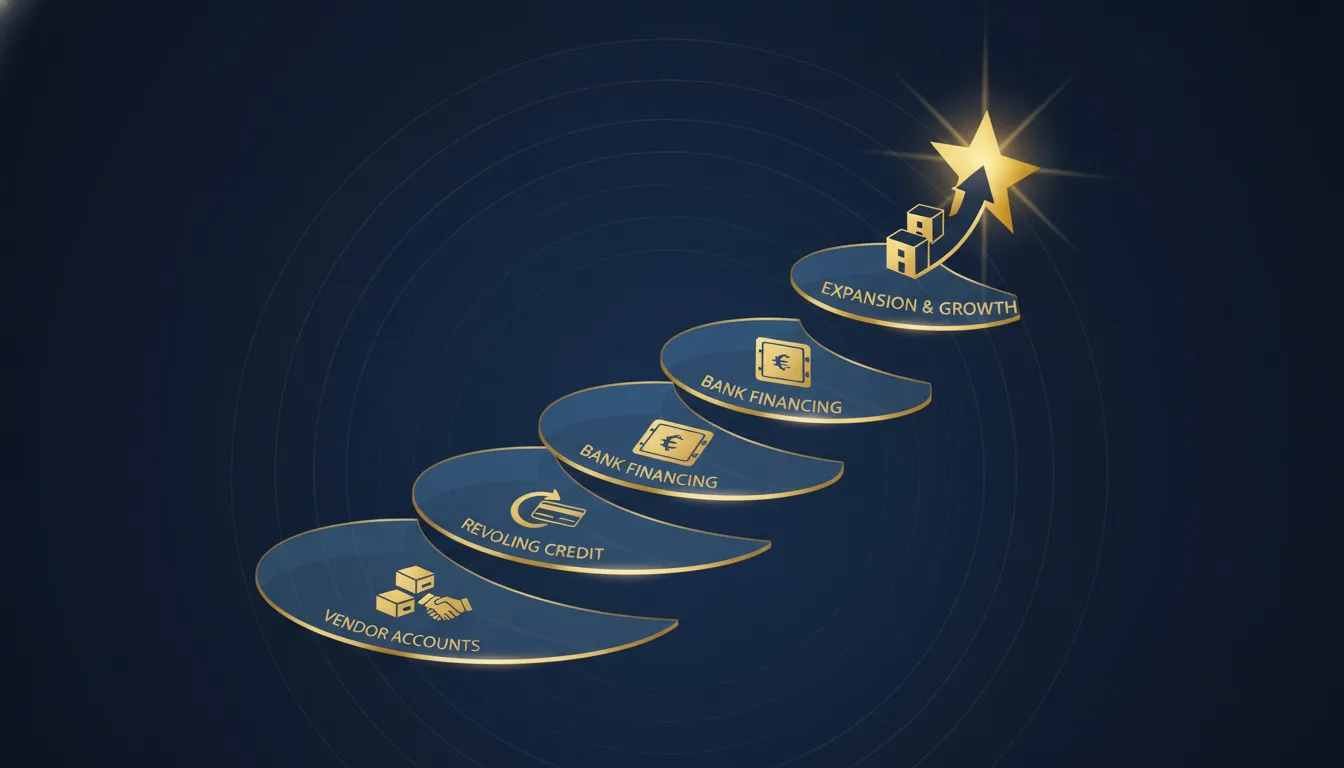
Business Credit Tiers: From Vendor Credit to Bank Financing
A strong business credit profile is not built with one application. It grows in stages, from small vendor accounts to larger credit lines and bank financing. Understanding business credit tiers helps you identify the accounts your company may be ready for now and the signals lenders want to see before approving the next level.
Get started with M1 Credit Solutions and build a stronger funding profile.
Business credit tiers describe a company’s path from starter vendor accounts to retail cards, revolving credit, and bank financing. Each tier generally requires stronger payment history, accurate business records, and greater financial readiness before lenders consider larger credit limits or loans.
Knowing how these levels work helps you compare your current profile with the signals lenders typically review. The path begins with a properly established business and starter trade accounts.
What are business credit tiers?
Business credit tiers are a way to group lenders and vendors based on their risk rules. New companies often start with no credit history. This makes it hard to get a big loan from a bank. Tiers give you a path to follow. You start with small accounts and move up as your company grows. This helps you build trust with lenders over time.
A roadmap for growth
Think of these tiers as a map for your company’s money. Each level has different rules. Lenders use business credit reports to see how you pay your bills. There is no single score for all businesses. Banks and shops use their own models to check for risk. Moving through the tiers helps you get more cash when you need it. It shows you can handle more debt as you grow.
The journey starts when you form your company as a legal entity like an LLC. This separates your personal life from your business. You also need a tax ID or EIN. Once you have these, you can start to apply for credit in your company’s name. You won’t get a huge line of credit on day one. You have to prove you are reliable by paying small bills first.
Different standards for different lenders
Lenders do not all use the same math to judge your company. Some look at your personal credit score. Others only care about your business history. Agencies like Dun & Bradstreet or Experian keep files on your company. Lenders look at these files to see your habits. If you pay on time, your score goes up. This lets you move to a higher tier with better rates.
In the first tier, you might work with vendors who give you 30 days to pay. These are often called net 30 accounts. As you move up, you can get store cards or bank loans. Each step builds your credit capacity. This is just a way to say how much you can pay back. Staying on top of your files is a continuous process that never really ends.
Build the foundation before climbing the tiers
You cannot climb the ladder of business credit tiers without a solid base. Lenders look for signs that your company is a real, distinct entity. Setting up these basics helps you separate your personal risks from your company’s risks. This step is the first move in how to establish business credit for the first time. It proves to banks and vendors that your firm is ready to handle debt.
Set up your legal structure
The first task is to form a separate legal entity like an LLC or a corp. This move creates a clear line between you and your firm. It is the core step for building a distinct business credit identity. Without this, lenders may only look at your personal files. Once your firm is set up, you must get an Employer Identification Number (EIN) from the IRS. This number acts like a social security number for your company and is needed for tax filing.
Open a business bank account
A dedicated bank account for your company is a must. It helps you track your funds and shows a clear trail of cash flow. Mixing your own money with company cash can lead to legal and tax issues. Lenders use your bank data to see how well you manage your daily costs. Keeping your records clean and up to date shows that your firm is professional. This trust is what helps you move from basic trade lines to larger bank loans later on.
- Form a legal entity. Structure your firm as an LLC or a corp to protect your assets and start your credit profile.
- Get your EIN. Apply for an EIN to identify your firm for tax filing and to open accounts in the company name.
- Pick a bank. Choose a bank that offers tools for small firms and open a business checking account to keep cash flow separate.
- Check your data. Ensure your firm’s name, phone, and address are the same on all files to avoid flags during the risk assessment process.
- Review your files. Look at your personal and company credit reports for errors before you start to apply for new lines of credit.
Tier 1: Starter vendor and trade credit
The first stage of building business credit tiers is often called Tier 1. This level aims at starter credit or basic trade credit. At this point, your firm likely has a small or no credit past. You start by working with vendors who give goods and services on credit.
This helps you build a file without a private promise from the owner. These early accounts are the base for your business credit name. They show that your firm can handle small debts on its own.
Trade credit with vendors
Most Tier 1 accounts are net 30 vendor accounts. This means you have 30 days to pay the full bill after you buy something. These firms let you buy office tools, shipping items, or cleaning supplies now and pay later. This setup is a type of short-term funding that helps you keep cash in your firm.
You might need to buy something first or leave some cash before a vendor gives you credit terms. You must use these accounts for items you already need. Do not buy things just to build credit. This shows lenders you are a wise buyer.
Service credit is a new way to start. This includes deals for your cell phone, web, and power. These firms often report your payment habits to business credit bureaus like Dun & Bradstreet or Experian. By paying these bills on time, you show that your firm is steady.
You can find more tips on how to start business credit through the Small Business Administration. These tips can help you find the right vendors for your needs.
Payments and reporting
Your goal in Tier 1 is to build a high credit score. To do this, you must pay every bill on or before the due date. Timely payments are the most vital factor for your score. Some vendors may charge a one-time fee or a monthly cost to report your data.
You should check that the vendor really reports to the major firms. If they do not report, your good habits will not help your credit file. Check your credit report each month to see which firms have added data. Some take longer than others to show up on your file.
It is also smart to keep your business and private costs apart. Using a business credit card that reports only to business bureaus can help protect your private credit. You should check your credit files often to make sure all data is right. Small errors can slow down your progress, so learn how to read a business credit report before funding.
Signals to move up
Once you have five to ten lines listed, you may be ready for Tier 2. You should have at least three to six months of on-time payments first. A strong Tier 1 base proves you can handle money debts. This trust allows you to get larger lines of credit and better terms later.
Moving up is part of a path that leads from simple trade credit to bank loans. Tier 2 credit often involves store cards and better trade terms. You will need these better terms to grow your work and buy more stock.
By digging this money well early, you make sure your firm has the funds it needs to grow. Your path through the five factors of business credit depends on this first step.
Tier 2: Retail and store credit
Tier 2 credit marks a shift from basic vendor accounts to retail and store credit cards. These accounts are often the next step after you have built a history with Net 30 vendors. Unlike basic trade credit, retail accounts let you buy items from major stores using your business credit profile. This tier helps you build a more diverse credit file that lenders like to see.
How store credit differs from vendor terms
Most Tier 1 accounts use Net 30 terms where you pay the full bill within 30 days. Retail credit often comes as a revolving line of credit. This means you can carry a balance if needed, but it is best to pay it off to avoid high interest. Many major brand retailers offer these store credit cards for businesses to help them buy supplies. Unless the card is co-branded with a major network, you can only use it at that specific store.
Store cards are useful for companies that buy from one place often. If you get your office gear or building tools from a specific shop, a store card makes those buys easier. These accounts also report to business credit bureaus. This helps you move closer to higher business credit tiers by showing you can manage revolving debt.
What lenders assess in Tier 2
Lenders look at more than just your age of accounts when you reach Tier 2. They check your payment history and how much of your credit limit you use. This is known as credit capacity or utilization. It is an evaluation of your company’s ability to repay a loan or line of credit. If you use too much of your limit, it might signal risk to a new lender.
Most retail lenders will also check if your business is set up right. They want to see an LLC or corporation and a valid EIN. Some may still look at the owner’s personal credit as a backup. Lenders use these reports to see how reliably your company handles its financial duties. Having three solid trade references can also help your application get approved.
Responsible use and readiness signals
To use Tier 2 credit well, you should keep your balances low. Aim to use less than thirty percent of your limit at any time. This shows you are not desperate for cash. It also keeps your score high as you aim for bank loans in Tier 3. Paying early is also a great way to stand out. Even paying a few days before the due date can help your score over time.
You are ready for Tier 2 when you have at least three to five reporting Tier 1 accounts. These accounts should show at least six months of on-time payments. Your business should also have a D-U-N-S number and a profile with major bureaus. Once you see these marks on your credit report, you can start applying for retail cards. This step builds the trust needed for future bank lending and larger lines of credit.
Use M1 Credit Solutions’ business credit building guide to plan your next tier.
Review your credit profile with M1 Credit Solutions before applying for the next tier.
Tier 3: Revolving and fleet credit
Reaching the third tier of business credit marks a major step for your firm. At this stage, you move beyond basic vendor accounts and start to use bank-backed lending tools. These tools offer more flex than net-30 terms. They give you the cash flow you need to grow fast and handle daily costs. Knowing how to manage these accounts is key to your success in the business credit tiers roadmap.
Revolving business credit cards
Revolving credit cards are a core part of this tier. Unlike a net-30 account, you do not have to pay the full bill every month. You can carry a balance, but you will pay interest on it. These cards are great for keeping your own and your business costs apart to protect your own credit files. The SBA says using a card that reports only to business agencies is the best way to keep these risks apart.
To stay in good standing, you must watch your credit limits. This is how lenders judge your power to pay back what you owe. High debt can hurt your score, even if you pay on time. It is best to keep your use of these cards low. This shows banks you are a safe bet. You can learn more about card types in our guide on secured vs unsecured cards for your business.
Fleet cards for business vehicles
If your firm has cars or trucks, fleet cards are a top choice in tier three. These cards work like credit cards but are only for gas, oil, and repairs. They help you track what your team spends on the road. Most fleet cards report your payments to business credit bureaus. This helps you build a stronger profile while you lead your team. These accounts often have high limits, so you must keep a close eye on your team’s spending habits.
Fleet cards also offer deep data on every buy. You can see which driver spent what and where. This makes tax time much easier for small firms. By paying these bills early, you show you can handle larger debt loads. This builds trust with big lenders who might offer you even better terms later. It is a smart way to use daily costs to build long-term trust with banks.
Readiness and the personal guarantee
How do you know if you are ready for this tier? Most firms move up after they have a few years of clean past with trade vendors. Lenders will look at your credit limits and your past payments. They want to see that you can handle larger lines of credit without fail. The SBA notes that lenders judge both the owner and the firm when they check your trust level.
Be ready to sign a personal guarantee (PG) for these cards. A PG means you agree to pay the debt if your firm cannot. While some firms want to avoid a PG, they are very common for Tier 3 bank products. Lenders want to see that you stand behind your firm. As your business credit grows, you may get better terms, but a PG is often the entry fee for high-limit revolving lines. Keeping your personal credit score high will help you get the best rates at this level.

Tier 4: Bank financing and larger credit
Reaching the fourth stage of the business credit tiers marks a major shift in how you fund your company. While early tiers focus on trade accounts with vendors, Tier 4 is where you gain access to bank lending and larger lines of credit. This level of business credit tiers growth shows that your company has a strong financial base and a history of on-time payments.
How bank lending works
Traditional banks look at much more than just a single score when they decide to lend. They check your credit capacity, which is a measure of your company’s ability to pay back a loan or a line of credit. According to the U.S. Small Business Administration, lenders also check how your business handles all its financial duties by looking at your credit report.
Banks often use these funds to provide term loans for big buys or lines of credit for daily cash flow. To get these, you must show that your business is stable and makes enough money to cover the new debt. Unlike starter credit, bank loans usually offer lower interest rates but have much stricter rules for who can get them.
The bank underwriting process
Bankers use a process called underwriting to judge the risk of lending to your company. They will ask for full financial records, such as tax returns and profit and loss sheets. These files help the bank see your cash flow and how long you have been in business. Most banks prefer to work with firms that have been active for at least two years.
You may also need to provide collateral or a personal guarantee to secure a larger loan. Lenders often look at both the personal credit of the owner and the credit profile of the business. Checking both files for accuracy before you apply is a vital step to avoid simple errors that could lead to a no.
Signs you are ready for Tier 4
You are likely ready for bank financing when your business credit file is thick and shows many types of credit. This includes trade lines from earlier tiers and perhaps a store credit card or a business gas card. A clean history with no late payments is the best signal to a bank that you are a safe bet for a larger loan.
Before you apply, make sure your legal structure is set up correctly as an LLC or a corporation. Having a tax ID number and a business bank account are also basic needs for any bank loan. Once these are in place, you can move toward getting the larger funds you need to grow your company even more.

Business credit tiers at a glance
Building your score is like digging a well for your firm. You start with small steps to find the cash you need to grow. Most lenders use business credit tiers to see how much risk you bring. There is no standard scoring model for all firms. Instead, your firm moves through four levels as it gets older and pays its bills on time. This journey acts as a roadmap to help you reach bank loans and big lines of credit.
The four levels of business credit
The journey starts when you form your legal entity. This creates a separate name from your own money. Most startups begin at Tier 1 with basic trade accounts. These are often net 30 terms where you pay for goods in a month. As you build a good track record, you can move to higher levels with more trust. Higher tiers offer more money and lower costs to help you scale.
Moving up the ladder helps you get bigger loans. You can go from store cards to full bank lines of credit. Each step shows that your firm is a safe bet for a lender. Use M1’s business credit building guide to get started on the right path. Strong scores can help you get better terms from your partners and sellers.
| Credit Tier | Account Type | Main Goal | Typical Signal | Key Caution |
|---|---|---|---|---|
| Tier 1 | Vendor Accounts | Build your name | Net 30 terms | High setup fees |
| Tier 2 | Retail Cards | Build history | Store credit | Store only use |
| Tier 3 | Bank Loans | Scale your firm | Lines of credit | Strict checks |
| Tier 4 | Equity Funding | High growth | Investors | Loss of control |
Moving through the tiers
To start, you must form an LLC or corporation first. This lets you get an EIN from the IRS. You then apply for small accounts with vendors that report to the bureaus. Some Tier 1 vendors may charge a fee to set up your account. It is smart to check for these costs before you sign up for any new line of credit.
Once you have a few accounts, keep your use low and pay early. This builds the trust you need to reach Tier 2 and Tier 3. Over time, you can get bank loans that help your firm grow even more. Each level brings you closer to the capital you need to reach your goals. Lenders look at your past to see if they can trust you with more money in the future.
Tips for faster growth
Focus on vendors that report your payments to the main bureaus. Not every store or seller will share your history. You want your hard work to show on your file. If you pay on time but no one reports it, your score will not move. Checking your reports often helps you see which accounts are helping you the most. You should also check for errors on your file that could hold you back.
Avoid taking on too much debt too fast. Lenders want to see that you can manage what you have. Slow and steady steps often lead to the best results. By building a solid base at Tier 1, you set yourself up for long-term success at higher levels. This base shows you are a solid partner who takes debt with care.
How do you know when you are ready for the next tier?
Moving through the business credit tiers is a slow task that rewards patience. Building your business credit is a long process that requires you to show good care over time. You should not rush to ask for new accounts before your old ones show success. If you ask too soon, banks may see you as a risk and deny your request. Knowing when to move up depends on your past payments, your files, and your cash flow.
Track Record of On-Time Payments
The most key sign that you are ready is a past of paying all your bills on time. Most Tier 1 accounts give you net 30 terms. This means you have 30 days to pay for what you buy. To move to Tier 2, you must show that you are a prompt payer. Lenders check your business credit report to see how you handle these debts. If you have missed any dates, stay in your tier until your record is clean.
Financial Document Readiness
You also need to have your papers in order before you seek higher credit lines. As you move toward Tier 3, banks will ask for more than just your EIN. They will look at your tax forms and your profit reports to judge your credit capacity. This is a measure of how well you can pay back what you borrow. You must show that your firm makes enough money to cover new debts. If your files have errors, you are not ready. You should check your files for accuracy before you take the next step.
Clear Goals for Your Funding
You should also have a clear plan for how you will use the new credit. Moving to a higher tier often brings larger loans or credit lines with better rates. You should only move up when you have a fixed goal, such as buying new tools or growing your team. Do not seek more credit just because it is there. A clear goal helps you choose the right path and avoid taking on debt that your firm does not need.
Asking for credit too quickly is a common error that can hurt your scores. Each new request can lead to a hard check on your report. Too many checks in a short time make a firm look in need of cash. Wait until you have at least three to five strong trade references in your current tier. This base of trust will help you get the better terms and lower rates found in the next level of funding.
Frequently Asked Questions
How do business credit tiers work?
Business credit tiers function as a growth ladder for your company. You start with basic trade accounts that report your on-time payments to credit bureaus. As your credit score improves and your history grows, you move to higher tiers. Each level provides access to more funding and better terms. According to the SBA, this process requires having a legal entity like an LLC and a tax ID number.
Are there business credit tiers for startups?
Yes, startups typically begin in the first tier. This level involves opening vendor accounts that do not require a long history or high revenue. These accounts often use net 30 terms, giving you thirty days to pay your bill. As you pay these early bills on time, you build the foundation needed for future tiers. The SBA notes that service credit is often the easiest type to get first.
Can you get business credit tiers with no credit check?
Many early tier accounts allow you to build credit without a hard check on your personal file. These vendors look at your business data instead of your own score. This helps you keep your personal and business finances separate from the start. However, moving into bank loans or large credit lines in later tiers may eventually need more data. Lenders use these reports to see if your company is a safe bet for a loan.
How to move up in business credit tiers?
Moving up requires consistent on-time payments and a mix of different account types. You should start with three or more trade references that report to the major agencies. Once you have a solid record, you can apply for store cards and revolving lines of credit. Each step shows lenders that you can handle more risk. It is also vital to check your credit file for any errors that could slow down your progress.
Ready to get business credit building guidance and grow today?
If you wait to build business credit, you must keep using your own cash to fund your firm, which puts your own assets at risk. This habit slows your growth and stops you from reaching your goals, while acting now lets you move through the tiers in just two months. Your firm needs a strong profile to get big loans, and waiting even one more week means you miss out on new ways to grow. You can protect your family and grow your firm faster by taking the first step to build your business credit score with us here today.
Ready to strengthen your funding profile? Get started with M1 Credit Solutions today and take the next step in your business credit journey.